
Collision with terrain
Horizon Helicopters Ltd.
Airbus AS350B, C-GHZN
Whitehorse/Erik Nielsen International Airport (CYXY), Yukon, 5.5 NM E
The Transportation Safety Board of Canada (TSB) investigated this occurrence for the purpose of advancing transportation safety. It is not the function of the Board to assign fault or determine civil or criminal liability. This report is not created for use in the context of legal, disciplinary or other proceedings. See Ownership and use of content. Masculine pronouns and position titles may be used to signify all genders to comply with the Canadian Transportation Accident Investigation and Safety Board Act (S.C. 1989, c. 3).
History of the flight
At approximately 1400All times are Mountain Standard Time (Coordinated Universal Time minus 7 hours). on 02 May 2025, the Horizon Helicopters Ltd.Horizon Helicopters Ltd. is authorized by Transport Canada to operate under Subpart 702 (Aerial Work) and Subpart 703 (Air Taxi Operations) of the Canadian Aviation Regulations (CARs). Société Nationale Industrielle Aérospatiale (Aérospatiale)Airbus Helicopters currently holds the type certificate for the aircraft type. AS 350B helicopter (registration C-GHZN, serial number 1749) departed Whitehorse/Erik Nielsen International Airport (CYXY), Yukon, for a training flight in support of the air operator’s Subpart 703 operation. Two pilots were on board: the training pilot and the candidate.Horizon Helicopter Ltd. calls a pilot providing instruction the training pilot and a pilot receiving instruction the candidate. The training pilot, who was a Transport Canada-approved check pilot (ACP), was hired on contract to provide training for Horizon Helicopters Ltd. The candidate had recently been hired by the company to replace the chief pilot and was completing the company’s helicopter training with the contracted training pilot. Both the training pilot and the candidate were wearing helmets.
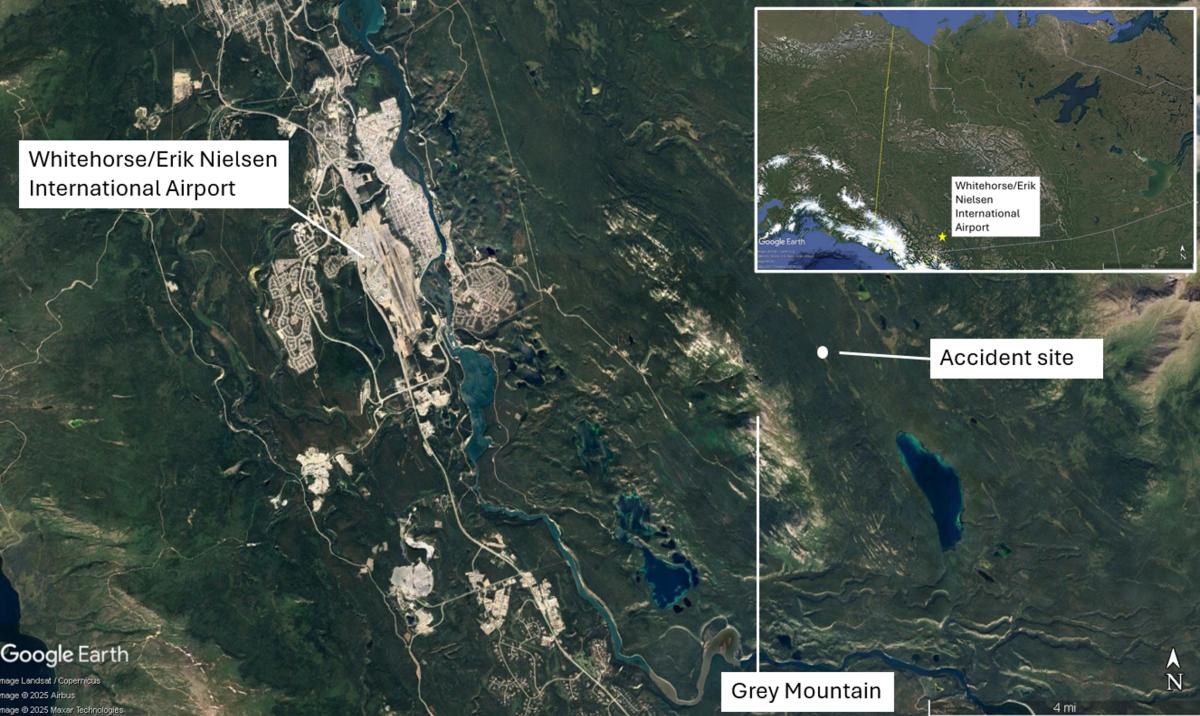
The training flight was conducted approximately 5.5 nautical miles (NM) east-southeast of CYXY,At the time of the occurrence, construction activity was being conducted on Runway 14R/32L at CYXY. in a valley immediately east of Grey Mountain (Figure 1). This area was commonly used by Horizon Helicopters Ltd. and was selected so that the exercises could be carried out without being interrupted by other air traffic. The floor of the valley was a dried lakebed that was clear of trees and obstacles. The lakebed surface was a clumpy, grassy area that had accumulated some ice and snow. Once down in the valley, there was little indication of wind direction, and the closest emergency services were at CYXY.
The 1st hour of the training flight included normal approaches, landing and taking off in a confined area, hydraulic system and tail rotor emergency procedures, steep turns, and hover exercises. The last exercises were straight-in and 180° autorotations with a power recovery to an overshootThe fuel flow control lever is left in the flight gate during the autorotation. conducted in a southerly direction into the valley to correspond with the predominant winds.
The last (5th) autorotation, flown by the candidate, was set up as a straight-in from the same direction as the previous autorotations and was entered when the helicopter was at approximately 1500 feet above ground level (AGL), travelling at 100 knots indicated airspeed (KIAS). Once the helicopter was established in the autorotation at an airspeed of approximately 60 KIAS, its rate of descent (ROD) was approximately 1400 fpm.
When the helicopter was at approximately 100 feet AGL and travelling at an airspeed of 65 KIAS, a flare was initiated and the ROD and airspeed decreased until the helicopter reached an airspeed of approximately 20 KIAS and a height of 70 feet AGL. At this time, the ROD increased and the airspeed decreased further, to 0 KIAS, with no reduction in ground speed. Neither pilot was aware that the winds had shifted direction by about 180°.
The training pilot identified that the helicopter had entered a fully developed vortex ring state (VRS)See the Vortex ring state section of the report for more information. and took control of the helicopter. He attempted to exit the VRS by gaining forward airspeed. At approximately 1510, the helicopter impacted terrain before it had recovered from the VRS.
The skid gear spread apart on initial impact and the tail rotor contacted the ground, rendering it ineffective. The helicopter then bounced and became airborne again. As the helicopter descended back to the ground, collective pitch was increased to arrest the ROD, but without the tail rotor, the helicopter began to rotate to the left. The training pilot was unable to reach the fuel flow control lever located on the floor between the front seats due to centrifugal forces. The helicopter was kept level until it impacted terrain a 2nd time, still rotating to the left. It then skidded along the ground until the left cross tube got caught on the ground, broke, and the helicopter rolled onto its left side (Figure 2).
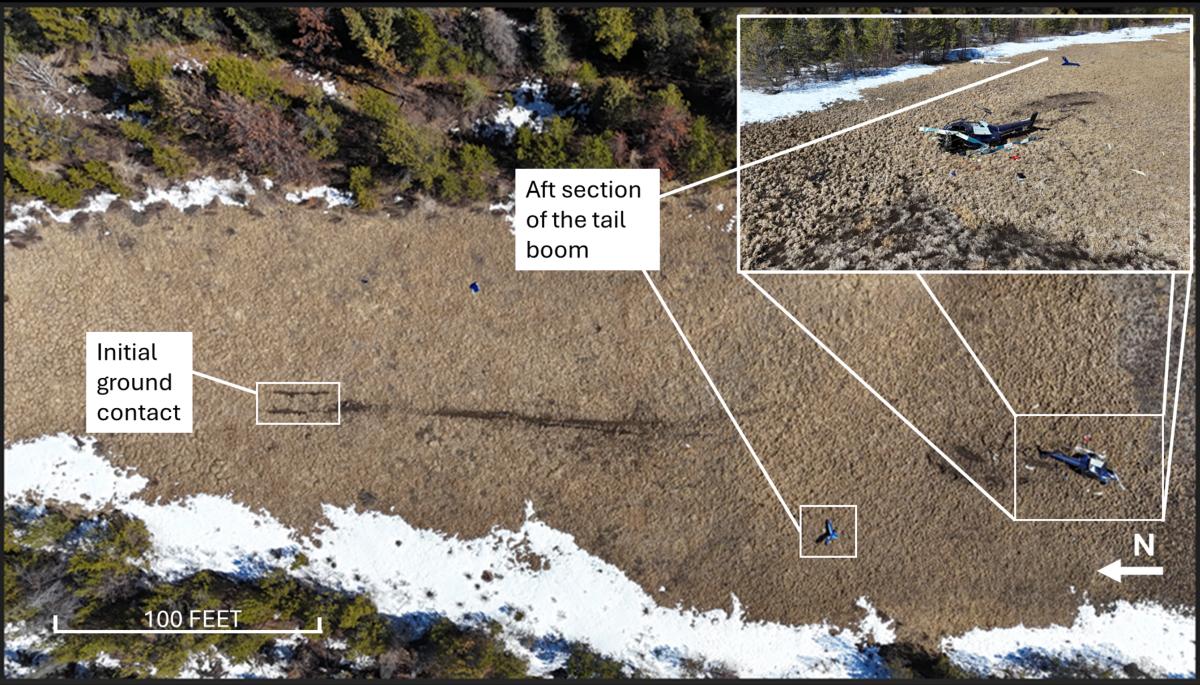
The main rotor blades impacted the ground as the helicopter rolled over and at least one of the main rotor blades entered the cabin over the front seats and struck the candidate. The training pilot then stopped the engine with the power lever and exited the helicopter. The emergency locator transmitter (ELT) activated and the Joint Rescue Coordination Centre in Victoria, British Columbia, received a signal at 1516. Once the helicopter had been secured, the training pilot called the company via a satellite phone and requested emergency medical services. The first emergency response helicopter arrived on scene at 1541. The candidate was fatally injured. The helicopter was destroyed.
Pilot information
Training pilot
The training pilot held a commercial pilot licence – helicopter and – aeroplane and a valid Category 1 medical certificate. His total helicopter flight time was approximately 13 000 hours, with approximately 7000 hours on type. He was experienced flying in the mountains and was familiar with the Grey Mountain area. In the 7 days before the occurrence, the training pilot had flown 19 hours on type. The occurrence flight was the training pilot’s 1st flight of the day.
Candidate
The candidate held an airline transport pilot licence – helicopter, a commercial pilot licence – aeroplane, and a valid Category 1 medical certificate. He had approximately 9800 hours total flight time and approximately 1900 hours on type. The occurrence flight was the candidate’s 1st flight of the day. He had accumulated 7 hours of flight time in the 7 days before the occurrence and 34.8 hours of flight time in the 30 days before the occurrence, of which 4.2 hours were on type. In the 90 days before the occurrence, the candidate had acquired 48 hours of flight time in an Airbus Helicopters H145.
The candidate began flight training with Horizon Helicopters Ltd. on 14 April 2025. The training was conducted on the occurrence helicopter, with various training pilots, and continued on 15 and 16 April 2025. On the occurrence flight, further training was being carried out, including autorotation training.
Autorotation training
An autorotation is defined as follows in Transport Canada’s Helicopter Flight Training Manual:
the condition of flight where the rotor is driven by aerodynamic forces, with no power being delivered by the engine. […] During autorotation the helicopter is still flying despite the fact that the engine is not delivering motive power to the rotors. It remains fully manoeuvrable albeit in descending flight. […] [T]he airflow is now upward through the disc rather than downward as in powered flight.Transport Canada, TP 9982, Helicopter Flight Training Manual, Second Edition (June 2006), p. 29.
An autorotation is conducted in a helicopter when the engine or engines fail or are shutdown as a precaution, allowing the pilot to safely land the helicopter without engine power. Autorotation training provides pilots with the skills needed to safely land a helicopter in the event of an engine failure or a tail rotor system failure.
During the occurrence flight, all autorotation training exercises were completed with the throttle at the flight gate, allowing the engine to maintain the rotor speed at 100%.
Section 1.2 of the AS 350B rotorcraft flight manual describes the autorotation training procedure as follows:
- Lower the collective lever to enter autorotation.
- Maintain NR within the green range of the NR indicator.
- Reduce fuel flow control lever while maintaining the Ng above 67 %.
- Apply autorotation procedure detailed in Section 3.1, paragraph 2.3, page 1 of the present Flight Manual except for the engine, fuel shut-off and electrical items.
- After landing, with the collective lever at full low pitch, return the fuel flow control lever to the flight detent.
- Rotor speed increases to its normal governed value.Airbus Helicopters, Flight Manual AS 350 B Supplement 6: Engine Failure Training Procedures, Issue 2 (22 May 2006), Section 1.2: Training procedure.
Vortex ring state
Helicopters are susceptible to an aerodynamic phenomenon known as VRS. VRS occurs when a helicopter’s flight path, airspeed, and ROD coincide with the helicopter’s downwash.Transport Canada, TP 9982, Helicopter Flight Training Manual, Second Edition (June 2006), p. 107. In normal flight, airflow from the main rotors is directed downward. In VRS, the tip vortices generated by the main rotors re-circulate through the rotor, adversely affecting lift. Applying more power (increasing collective pitch) serves to further accelerate the downwash through the main rotor, exacerbating the condition. In a fully developed VRS, the helicopter may experience uncommanded pitch and roll oscillations, and the ROD may approach 6000 fpm.Federal Aviation Administration, FAA-H-8083-21B, Helicopter Flying Handbook (2019), p. 11-9.
As explained in Airbus Safety Information Notice No. 3123-S-00,
VRS is especially dangerous when the aircraft is close to the surface, as there may be insufficient altitude to accomplish a recovery. Attempting to land with a tailwind or allowing an unmanageable ROD [rate of descent] to occur while attempting to Hover Out of Ground Effect (HOGE), are two situations which often lead to VRS. However, other maneuvers such as external load operations, low airspeed decelerative turns to a downwind position, or rapid decelerations during descent, can quickly develop into VRS if airspeed and RoD are not closely managed.Airbus Helicopters, Safety Information Notice No. 3123-S-00: Useful information about the Vortex Ring State (VRS) phenomenon, Revision 1 (12 April 2022), p. 3.
The Helicopter Flying Handbook published by the U.S. Federal Aviation Administration (FAA) identifies the following combination of conditions as being likely to cause VRS:
- a vertical descent or nearly vertical descent of at least 300 fpm;
- powered flight, typically within the range of 20-100% engine torque; and
- horizontal velocity that is slower than effective translational lift.Federal Aviation Administration, FAA-H-8083-21B, Helicopter Flying Handbook (2019), p. 11-10.
To avoid VRS during approach and landings, Airbus Safety Information Notice No. 3123-S-00 recommends the following:
When the airspeed is below 30 knots be aware of your RoD [rate of descent]. Use collective pitch (power) to control vertical speed. NEVER ALLOW AN RoD GREATER THAN 500 fpm WHEN BELOW 30 KIAS. AVOID AGGRESSIVE DECELERATIONS WHILE IN DESCENT OR WHEN TURNING TO A DOWNWIND POSITION. [emphasis in original]Airbus Helicopters, Safety Information Notice No. 3123-S-00: Useful information about the Vortex Ring State (VRS) phenomenon, Revision 1 (12 April 2022), p. 11.
To reduce the risk of entering VRS, helicopter pilots are trained to avoid entering their helicopter’s own downwash. Should pilots of single main-rotor helicopters find themselves in VRS, Transport Canada recommends the following 2 recovery methods:
- Dive out. Normally this technique will result in less altitude loss than with the autorotational recovery. The pilot should apply forward cyclic while reducing the collective; the vortices will leave the disc as the airspeed increases and the helicopter will move forward of its downwash. Normal flight may then be resumed.
- Enter autorotation. By this method, the airflow through the rotor changes from the disturbed flow of the vortex ring to the upward autorotational flow. Once autorotational descent has commenced then the pilot may ease the cyclic forward to gain airspeed while power is increased and normal flight resumed.Transport Canada, TP 9982, Helicopter Flight Training Manual, Second Edition (June 2006), p. 107.
Typically, a helicopter in VRS will lose considerable altitude before it is able to resume normal flight. If insufficient altitude is available, the helicopter may impact the ground before it is able to recover from VRS.
Ideally, helicopters should be positioned into the wind for final approach to reduce the risk of entering VRS. A pilot conducting a downwind approach must carefully manage the helicopter’s ground speed, power, and ROD to prevent the helicopter from descending into its own downwash and being caught in it, possibly at an altitude from which recovery is impossible.
Aerodynamic conditions that cause VRS are not present during an autorotation because the rotor system is being driven by the airflow moving up through it; however, VRS can be encountered during a power recovery.
Aircraft information
The Aérospatiale AS 350B is a 6-seat, single-pilot, turbine-powered helicopter. On the occurrence helicopter, a Honeywell LTS101-600A-3A, free turbine, turboshaft engine replaced the original engine in accordance with Supplemental Type Certificate (STC) SH5815SW.
At the time of the occurrence, there were no documented defects in the helicopter’s journey log. The last entry in the journey log, dated 01 May 2025, was a daily inspection carried out by a company pilot, which included repetitive inspections required by an ongoing airworthiness directive. There were no entries for the occurrence flight.
The helicopter’s weight and balance were within the manufacturer’s limitations.
Weather information
The aerodrome routine meteorological report (METAR) issued for CYXY at 1500 reported the following:
- Winds from 140° true (T) at 15 knots, gusting to 23 knots
- Visibility of 25 statute miles (SM) with showers in the vicinity
- Few clouds at 3500 feet AGL, with a broken ceiling of towering cumulus clouds at 6500 feet AGL, a broken cloud layer at 10 000 feet AGL, and a broken cloud layer at 24 000 feet AGL
- Temperature 10 °C and dew point 4 °C
- Altimeter setting 29.33 inches of mercury (inHg)
Aircraft operating in mountainous regions can encounter various phenomena such as mechanical turbulence, and channelling, funnelling, converging, or diverging winds, all of which can affect an aircraft.NAV CANADA, The Weather of the of the Yukon, Northwest Territories and Western Nunavut Graphic Area Forecast 35, at https://www.navcanada.ca/en/lawm-yukon-nwt-en.pdf (last accessed on 23 January 2026).
Upon entering the training area, the training pilot noted that the wind varied in speed and direction on the east side of Grey Mountain. The wind conditions in the valley being used for training were assessed as being at a steady speed from the south.
Following the accident, the training pilot observed that the winds were calm for approximately 10 minutes before they began to blow from either end of the valley at varying speeds.
TSB laboratory reports
The TSB completed the following laboratory report in support of this investigation:
- LP034/2025 – NVM [non-volatile memory] Data Recovery – Flight Tracker and GPS [global positioning system]
Safety action taken
On 09 May 2025, Horizon Helicopters Ltd. implemented a policy that emergency training will be conducted at an airport with suitable facilities to report or indicate wind direction and speed.
Safety messages
When conducting power recoveries after an autorotation, pilots should be aware that there is a risk of the helicopter entering VRS, which increases in tailwind conditions. To ensure that autorotations are conducted into wind, it is important that autorotation training be conducted at a location where wind direction and velocity are easily observed, such as an airport.
This report concludes the Transportation Safety Board of Canada’s investigation into this occurrence. The Board authorized the release of this report on 18 February 2026. It was officially released on 10 March 2026.