
Collision with terrain
West Coast Helicopters Maintenance and Contracting Ltd.
American Eurocopter an EADS Company AS350 B2 (helicopter), C-GWCT
Brooks Peninsula, British Columbia
The Transportation Safety Board of Canada (TSB) investigated this occurrence for the purpose of advancing transportation safety. It is not the function of the Board to assign fault or determine civil or criminal liability. This report is not created for use in the context of legal, disciplinary or other proceedings. See Ownership and use of content. Masculine pronouns and position titles may be used to signify all genders to comply with the Canadian Transportation Accident Investigation and Safety Board Act (S.C. 1989, c. 3).
History of the flight
At approximately 0815All times are Pacific Daylight Time (Coordinated Universal Time minus 7 hours). on 15 August 2024, the American Eurocopter an EADS CompanyAirbus Helicopters currently holds the type certificate for the aircraft type. AS350 B2 helicopter (registration C-GWCT, serial number 7449), operated by West Coast Helicopters Maintenance and Contracting Ltd.,West Coast Helicopters Maintenance and Contracting Ltd. is based at the Port McNeill airport (CAT5), British Columbia, with a fleet of more than 15 aircraft. It provides helicopter support for activities such as tourism, mining, forestry, fire suppression, and environmental research under Canadian Aviation Regulations (CARs) subparts 702 (Aerial Work) and 703 (Air Taxi Operations). The occurrence flight was being conducted under Subpart 703 of the CARs. departed Port McNeill Aerodrome (CAT5)All locations mentioned in the report are in the province of British Columbia, unless otherwise indicated. on a day visual flight rules (VFR) flight in support of moving personnel and equipment to a job site approximately 32 nautical miles (NM) to the southwest of CAT5 that serves as a remote sensing location. The pilot and 1 passenger were on board.
Although the itinerary for the day included 9 flight legs, only 3 were initiated (Figure 1):
- Leg 1: from CAT5 to the job site to confirm where equipment would be delivered (Figure 1).
- Leg 2: from the job site to a staging area, approximately 11 NM to the north, where the passenger would be dropped off and a load of equipment would be attached to the helicopter’s longline to be delivered back to the job site.
- Leg 3: from the staging area back to the job site.
The accident occurred at the end of the 3rd leg.
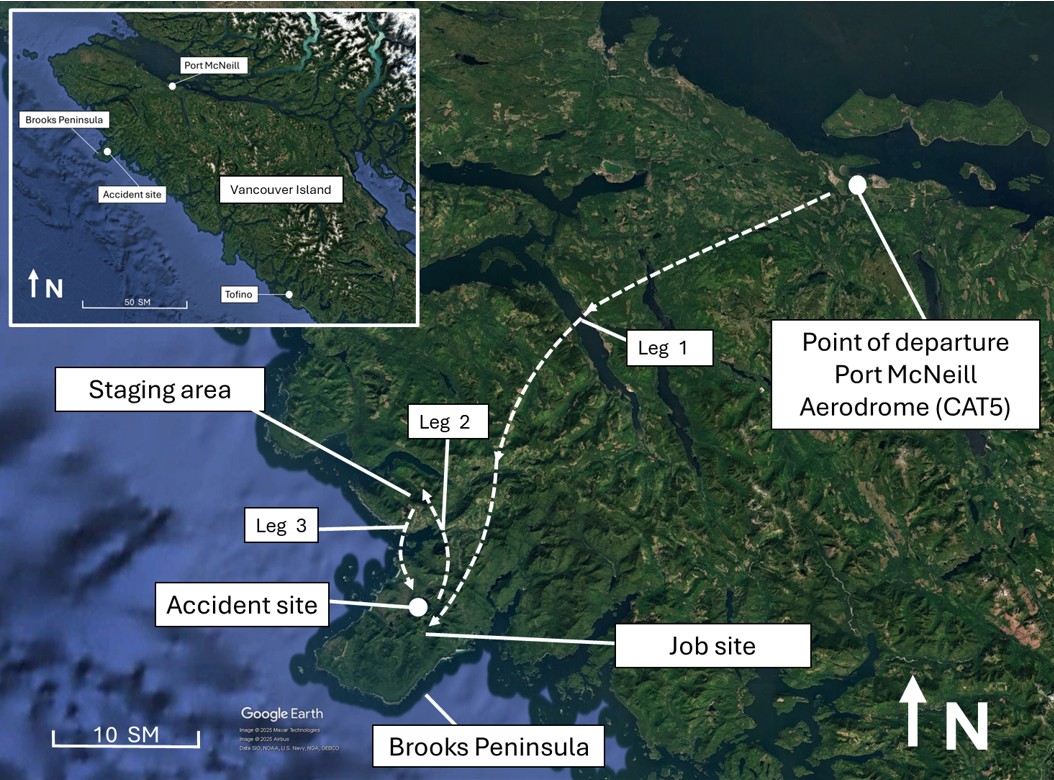
The flight to the job site was uneventful. After landing, the pilot and passenger remained in the helicopter and discussed the proposed cargo drop locations at the job site. They then flew to the staging area, where the pilot and passenger exited the helicopter. The pilot connected the longline equipment, returned to the helicopter, and then lifted off, remaining in a hover while the passenger and 3 customer technicians prepared 2 loads to be transported to the job site. One of the loads weighed approximately 1400 pounds and the other weighed approximately 600 pounds (Figure 2).
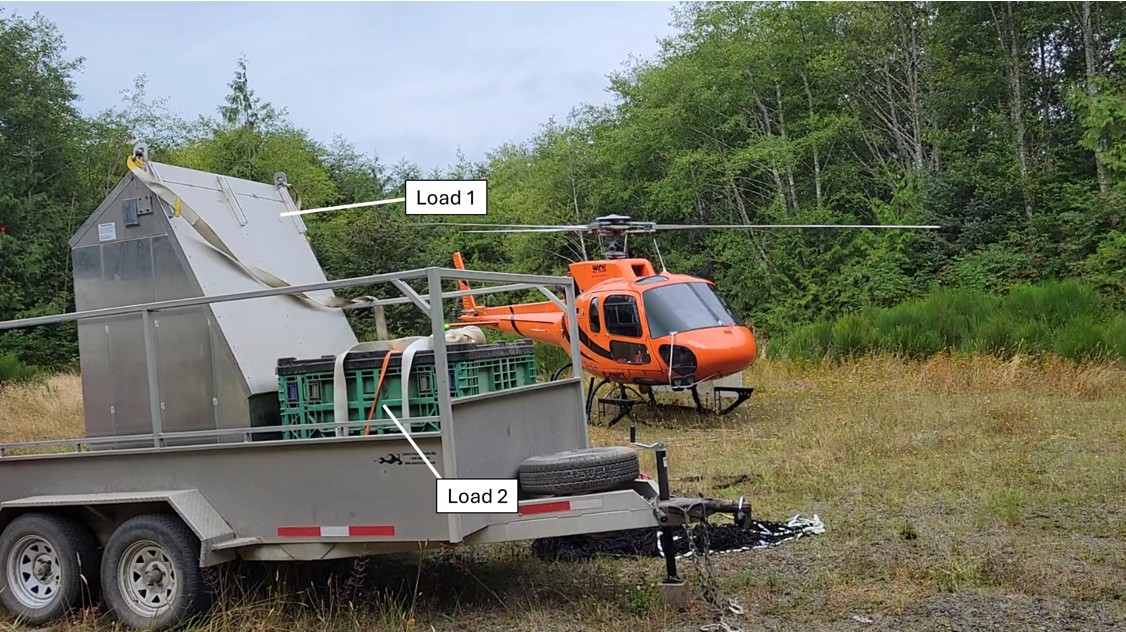
The pilot took the heavier load first.The 1st load was a geological sensing equipment enclosure called a hut or kiosk. The exterior was unpainted metal, and the dimensions were approximately 60 inches × 50 inches and 80 inches tall. The load was connected to the longline assembly consisting of a 75-foot synthetic cable with an additional 20 feet of lanyard.A lanyard is a shorter line or cable that connects the load to the longline. It is used to stabilize and secure the load during transport. While the longline provides the primary lift and mobility, the lanyard helps control the load’s positioning. The longline assembly’s release mechanism, which allows for detachment of the load, is typically integrated into the longline, not the lanyard. In addition to the load, a 40-pound net was attached to the load to improve flight stability. At 0931, the helicopter lifted off with the external load attached. Shortly after liftoff, the pilot reported by radio that the load was within weight limitations and stable. The helicopter was observed flying normally until it flew beyond the customer technicians’ line of sight. The helicopter was expected to return within 30 minutes for the 2nd load.
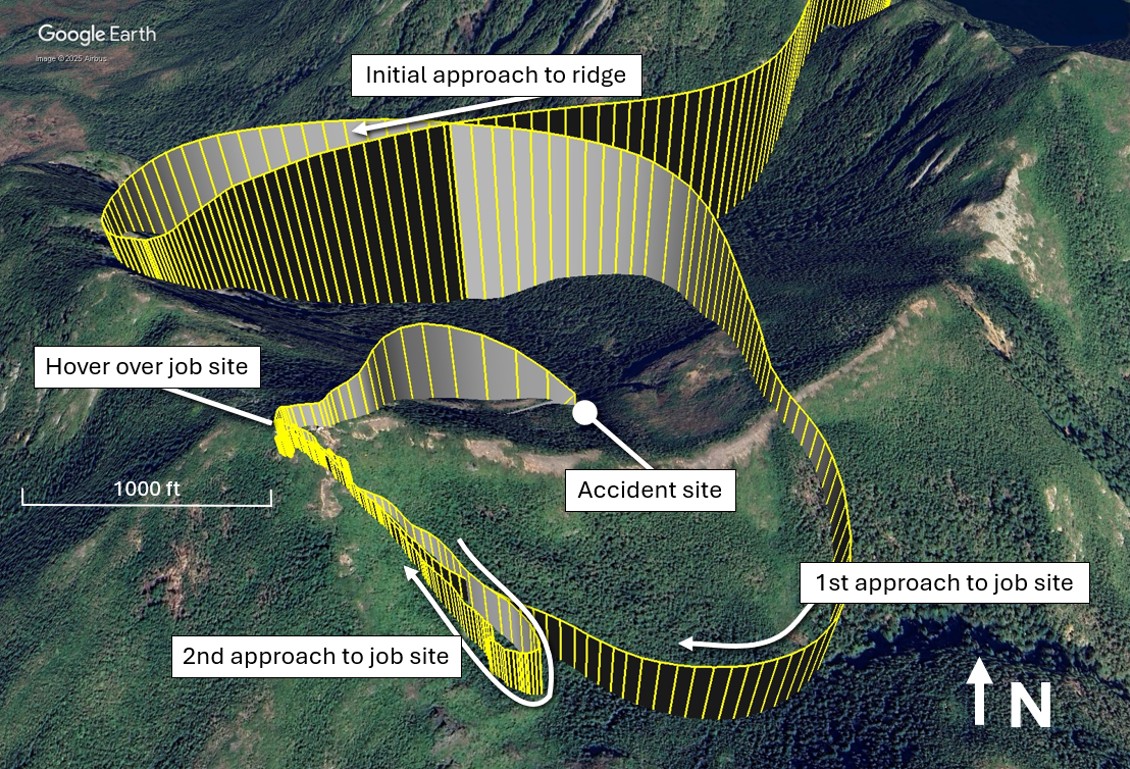
According to the on-board satellite trackingThe helicopter was equipped with a Spidertracks satellite-based aircraft tracking system. The investigation used data from the system to determine the helicopter’s flight profile. equipment, the helicopter proceeded south and approached a ridge approximately 1300 feet north of the job site at 0941; the pilot was likely planning to approach the site from the northwest. The helicopter did not cross the ridge, instead it turned back east from the ridge at 0943, flew south, and approached the job site again, this time from the southeast. At 0944, the helicopter began the approach and arrived over the job site approximately 1 minute later. After hovering for approximately 2 minutes, the helicopter departed at 0947 for unknown reasons and flew approximately 800 feet southeast before returning over the job site at 0949.
The helicopter hovered over the job site for 3 minutes, at a heightThe helicopter’s height was derived from its global positioning system (GPS). GPS-derived altitude data are subject to error when compared with an aircraft’s actual height above ground. Variations can arise due to satellite geometry, signal multipath, or receiver limitations, and discrepancies of several tens of feet are possible, particularly at lower altitudes. As a result, GPS altitude information may not accurately reflect the aircraft’s true vertical position relative to terrain or obstacles. of approximately 100 feet above ground level (AGL) (approximately 2500 feet above sea level [ASL]). At 0952, the helicopter departed to the northeast and initiated a shallow climb. Approximately 20 seconds later, the final recorded global positioning system (GPS) position indicated that just before the accident, the helicopter was on a northeast track, travelling at approximately 60 knots ground speed (Figure 3). Its final descent rate exceeded 9000 fpm.
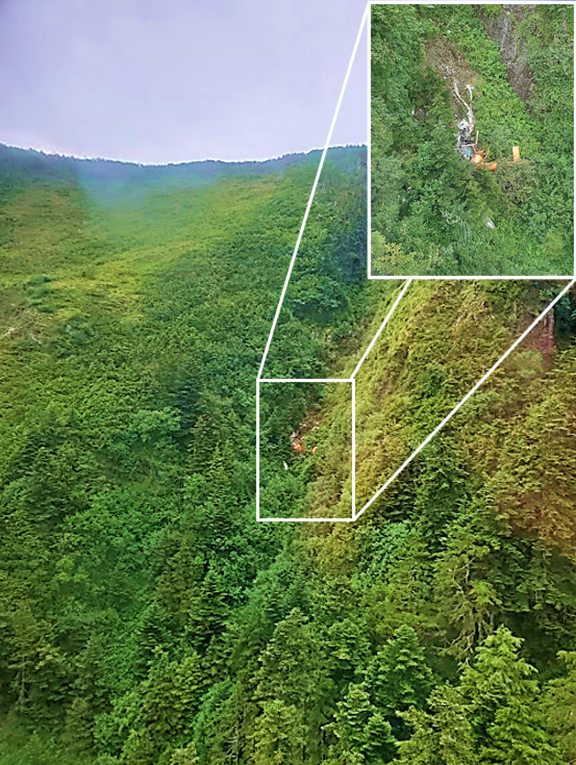
Approximately 1 hour later, the 3 customer technicians reported the helicopter overdue. Another company aircraft was diverted to search for the missing helicopter; however, poor weather impeded the search efforts. Eventually, the wreckage was spotted in a gully in remote terrain, approximately 1000 feet northeast of the job site.
The helicopter had impacted terrain in a nose-down attitude and was destroyed (Figure 4). There was no post-impact fire. The pilot was the sole occupant and was fatally injured.
There was an impact scar on the ground approximately 450 feet west of the helicopter impact site, which is consistent with the load having impacted terrain after being released in flight. The load appears to have then rolled 125 feet downhill and come to rest approximately 325 feet from the helicopter impact location. The longline was still connected to the load, which is consistent with the load being intentionally released from the helicopter belly hook attachment point. The investigation did not discover any damage to the longline or hook assemblies. There was no indication that the load came into contact with trees or terrain before being released by the pilot.
Weather information
Environment and Climate Change Canada conducted a post-accident weather analysis. In summary, the report concluded that from 0900 to 1100 on 15 August 2024, weather conditions near Brooks Peninsula included a broken layer of stratus clouds over western Vancouver Island, with Tofino/Long Beach Airport (CYAZ), approximately 96 NM southeast of the accident site, reporting cloud bases as low as 400 feet AGL. Stratocumulus clouds based between 4000 and 7000 feet ASL were reported over the northern and eastern parts of the island. Winds near Brooks Peninsula were locally accelerated to approximately 20 knots due to terrain-induced convergence. Upper air soundings and radar data indicated the presence of elevated convection near 10 000 feet AGL, producing scattered showers and potential virga, which could have resulted in localized turbulence. Surface-based convection was unlikely owing to stable low-level atmospheric conditions. No significant weather hazards were reported at Port Hardy Airport (CYZT), which is 35 NM north-northeast of the accident site. Given that the accident site was at an elevation of 1867 feet ASL, it is likely that the surrounding area was obscured at the time of the accident.
During search efforts, approximately 2 hours after the accident, the search pilot reported that the visibility in the vicinity of the job site varied from good to completely obscured by cloud or fog.
Pilot information
The pilot held a commercial pilot licence – helicopter and a valid Category 1 medical certificate. His total flight time was approximately 1260 hours, and he had experience in a variety of light helicopters, including approximately 50 hours of flight time in the AS350 B2 as pilot-in-command and approximately 30 hours of longline operations, mostly on a different make and model of helicopter.
As part of his initial training, the pilot completed all computer-based ground training and flight training in February 2024. The pilot was trained in accordance with the company operations manual (COM) and the requirements in Canadian Aviation Regulations (CARs) Subpart 702. The COM stipulated that the pilot must remain clear of cloud and must maintain a minimum visibility of ½ mile in uncontrolled airspace when operating below 1000 feet AGL and the minimum safe airspeed of 65 mph.West Coast Helicopters Maintenance and Contracting Ltd., Company Operations Manual (15 November 2022), Section 4.1.2: Flight Operations in Reduced Visibility, p. 4-1. The pilot received the required 0.1 hours of low-visibility training and had been tested and assessed as competent in aspects of low-visibility encounters.Ibid., Section 6.21: Low Visibility Training, p. 6-11.
The pilot had not flown for at least 10 days before the accident. There was no indication that the pilot’s performance was negatively affected by medical factors or fatigue.
Aircraft information
The occurrence helicopter was equipped with a Turbomeca Arriel 1D1 engine. It was also equipped with an external cargo basket installed on its left side. Before the day of the accident, the helicopter had acquired 8251 hours of total flight time. At the time of the occurrence, there were no reported outstanding defects or known deficiencies with the helicopter.
Based on available information about equipment and personnel on board the helicopter, the helicopter’s weight and centre of gravity were within the prescribed limits.
The helicopter was certified and equipped for daytime VFR flight in accordance with section 605.14 of the CARs.Transport Canada, SOR/96-433, Canadian Aviation Regulations, section 605.14.
Post-accident examination
The TSB examined the helicopter after it was recovered from the accident site. All major components of the helicopter were available for examination.
Owing to the extent of the damage, functional tests of the aircraft systems could not be performed; however, there were no signs of a system malfunction that would have affected the controllability of the helicopter.
Inadvertent flight into instrument meteorological conditions
The term “inadvertent flight into instrument meteorological conditions” (IIMC) refers to situations where a pilot, operating under VFR, unintentionally flies into instrument meteorological conditions (IMC), which are “meteorological conditions less than the minima specified in [the CARs] for visual meteorological conditions, expressed in terms of visibility and distance from cloud.”Ibid., section 101.01.
Studies in helicopter pilot performance indicate that IIMC poses a significant risk to helicopter flight safety.United States Helicopter Safety Team, “56 Seconds to Live” Unintended Flight in Instrument Meteorological Conditions (IIMC): Safety Initiative (15 June 2021), at https://ushst.org/wp-content/uploads/2021/06/56-Seconds-to-Live-Report-15-Jun-2021.pdf (last accessed on 09 April 2026). The most prominent schools of thought on what to do in the case of IIMC are to avoid it completely or to provide pilots with sufficient training to either safely exit the conditions or continue flight using the helicopter’s flight instruments rather than external visual cues.For a more detailed discussion on managing the risks of inadvertent flight into instrument meteorological conditions, see TSB Air Transportation Safety Investigation Report A21C0038. These skills are normally acquired when obtaining an instrument rating. The helicopter was not equipped for flight in accordance with instrument flight rules (IFR) and the pilot did not hold an instrument rating; however, the helicopter was equipped with the instruments requiredThe helicopter was certified and equipped for daytime VFR flight in accordance with section 605.14 of the Canadian Aviation Regulations (CARs). Flight instrumentation included an airspeed indicator, an artificial horizon, a turn coordinator that incorporated a ball-in-tube slip and skid indicator, a barometric altimeter, a gyroscopic direction indicator, and a vertical speed indicator. for an escape from IIMC.
The TSB has investigated previous occurrences related to helicopter operations involving heightened risk of operation in limited visibility.TSB air transportation safety investigation reports A23Q0038, A23W0091, and A21C0038. Following its investigationTSB Air Transportation Safety Investigation Report A21C0038. into an Airbus Helicopters AS350 B2 accident on Griffith Island, Nunavut, on 25 April 2021, the Board issued 3 recommendations that aim to mitigate risks associated with IIMC. The Board recommended that actions be taken to ensure that pilots possess the skills necessary to recover from IIMC;Transportation Safety Board of Canada, Recommendation A24-01: Recovery from inadvertent flight into instrument meteorological conditions, at https://www.tsb.gc.ca/eng/recommandations-recommendations/aviation/2024/rec-a2401.html (last accessed on 09 April 2026). that technology be implemented on commercial helicopters to assist pilots with the avoidance of, and recovery from, IIMC;Ibid., Recommendation A24-02: Technology as a defence against inadvertent flight into instrument meteorological conditions accidents, at https://www.tsb.gc.ca/eng/recommandations-recommendations/aviation/2024/rec-a2402.html (last accessed on 09 April 2026). and that reduced-visibility helicopter operations requirements be enhanced.Ibid., Recommendation A24-04: Enhanced risk mitigation for reduced-visibility operations in uncontrolled airspace, at https://www.tsb.gc.ca/eng/recommandations-recommendations/aviation/2024/rec-a2404.html (last accessed on 09 April 2026).
TSB laboratory reports
The TSB completed the following laboratory reports in support of this investigation:
- LP011/2024 – Annunciator Panel Analysis
- LP154/2024 – NVM [non-volatile memory] Data Recovery – PEDs [personal electronic devices]
- LP184/2024 – NVM Data Recovery – Appareo, Spidertracks, VEMD [vehicle and engine multifunction display]
Safety message
VFR flight in reduced-visibility conditions is particularly hazardous in mountainous terrain. To mitigate the risks associated with IIMC, it is important for operators and pilots to establish—and adhere to—operational visibility and altitude limits. These limits are sometimes referred to as en route decision triggers and they support pilot decision making by defining minimum visibilities and/or altitudes that once reached, necessitate alternative action.
This report concludes the Transportation Safety Board of Canada’s investigation into this occurrence. The Board authorized the release of this report on 18 March 2026. It was officially released on 23 April 2026.