
Collision with terrain
KBM Forestry Consultants Inc.
Cessna U206F, C-FKZO
Lloydminster Airport (CYLL), Alberta, 7 NM SE
The Transportation Safety Board of Canada (TSB) investigated this occurrence for the purpose of advancing transportation safety. It is not the function of the Board to assign fault or determine civil or criminal liability. This report is not created for use in the context of legal, disciplinary or other proceedings. See Ownership and use of content. Masculine pronouns and position titles may be used to signify all genders to comply with the Canadian Transportation Accident Investigation and Safety Board Act (S.C. 1989, c. 3).
History of the flight
At 1447All times are Central Standard Time (Coordinated Universal Time minus 6 hours). on 08 September 2024, the Cessna U206F aircraft (registration C-FKZO, serial number U20602133) operated by KBM Forestry Consultants Inc. departed Kindersley Regional Aerodrome (CYKY), Saskatchewan, for the 2nd portion of a visual flight rules aerial power line inspection flight in an area to the southeast of Lloydminster Airport (CYLL), Alberta, with 2 crew members on board. The flight was part of a multi-day pairing for a contract to photograph power lines. The crew shared the duties of pilot and observer; whoever flew in the morning operated the cameras in the afternoon.
The investigation obtained photos and video from the onboard cameras. The last series of photos and video showed that the aircraft flew over an intersection of power lines that the observer photographed twice (photos 4151 and 4152 in Figure 1). The next photo (photo 4153 in Figure 1) is of the next pole in the power line. The pilot then turned approximately 190° to the right to allow the observer to take 2 additional photos (photos 4154 and 4155 in Figure 1) of the intersection of power lines.
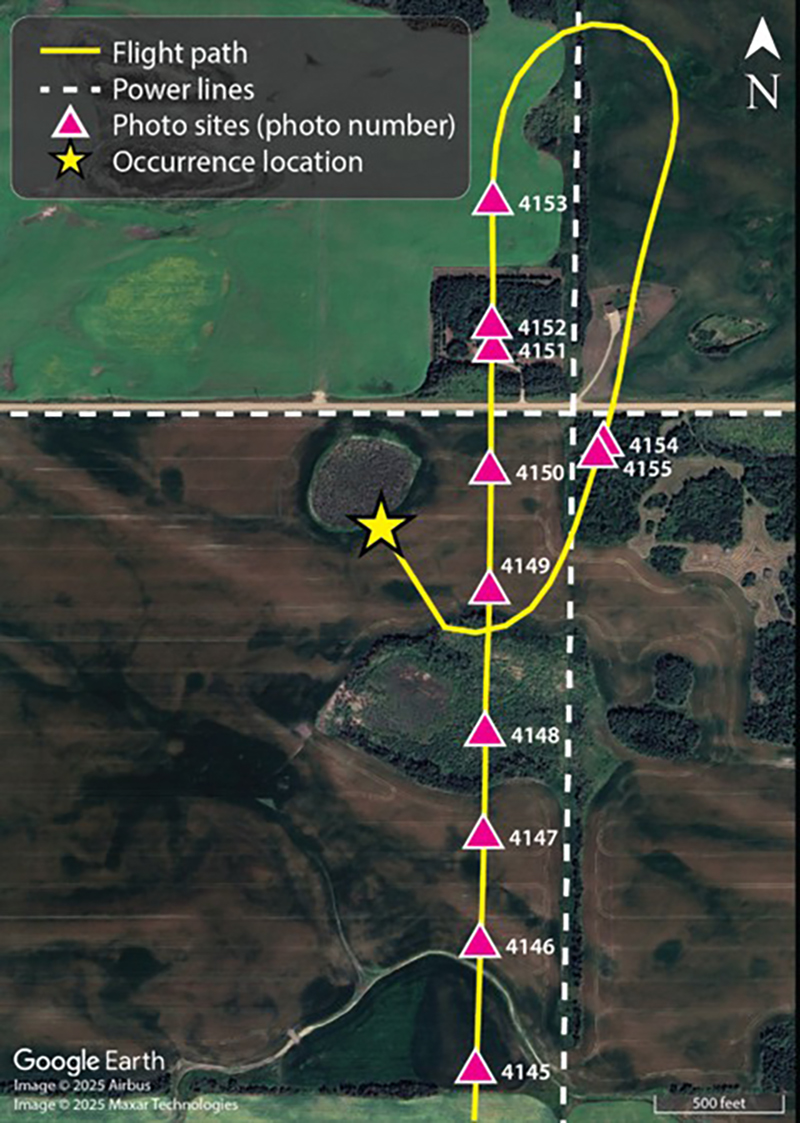
After the last photo was taken (photo 4155 in Figure 1), at 1753, the pilot started a right turn at a height of approximately 200 to 300 feet above ground level (AGL), likely to return to the original flight path to continue along the power line. During the turn, the aircraft stalled and its bank angle to the right increased. While the aircraft was descending at a rate of at least 3000 fpm, it began to roll to the left toward a wings-level attitude. Three seconds after the stall began, the aircraft impacted terrain (Figure 2).
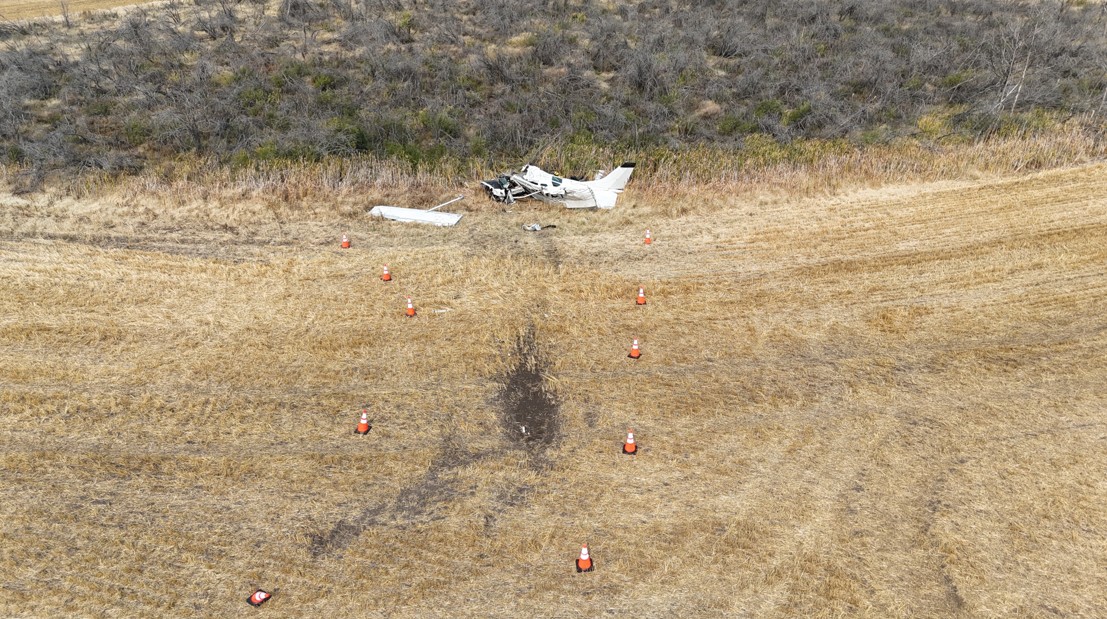
The pilot received fatal injuries. The observer received serious injuries and died 3 days later.
The aircraft was destroyed. There was no indication of fire either before or after the occurrence.
Crew information
The crew held the appropriate licences and ratings for the flight in accordance with existing regulations. Their pilot competency checks were valid; they had received the required training per the company operations manual,KBM Resources Group, Company Operations Manual, Amendment #10 (01 June 2023), section 6-4-11: Low Altitude Training, p. 6-13; and section 6-4-13: Aerial Work Training, p. 6-14. which included low altitude training, stall awareness, safe turn management, and aerial work; and they had received training on conducting photo flights.
The pilot had been working for the air operator since April 2024. He had 583 hours total flight time, of which 323 hours were on the Cessna 206 series aircraft. The observer had been with the air operator since July 2022. He had 314 hours total flight time, of which 115 hours were on the Cessna 206 series aircraft.
There was no indication that the crew’s performance had been negatively affected by medical or physiological factors.
Weather information
The aerodrome routine meteorological report (METAR) for CYLL issued at 1800 indicated the following:
- Winds from 160° true at 9 knots
- Visibility of 15 statute miles (SM)
- Sky clear
- Temperature 28 °C and dew point 7 °C
- Altimeter setting 29.79 inches of mercury (inHg)
- Density altitude 4400 feet
Weather was not considered to be a factor in this occurrence.
Aircraft information
The occurrence aircraft was a Cessna U206F equipped with a Robertson STOL [short takeoff and landing] kit,Supplemental Type Certificate STC SA1513WE. a rear-facing observer seat, as well as video and still-image cameras. The right aft door was removed for clear visibility of the power lines from the cameras.
Manufacturer | Cessna Aircraft Company* |
|---|---|
Type, model, and registration | U206F, C-FKZO |
Year of manufacture | 1973 |
Serial number | U20602133 |
Certificate of airworthiness issue date | 17 August 1973 |
Total airframe time | 5629.0 hours |
Engine type (number of engines) | Continental IO-520-F (1) |
Propeller type (number of propellers) | Hartzell PHC-C3YF-1RF/F84684-6R (1) |
Maximum allowable take-off weight | 3600 lb (1632.93 kg) |
Recommended fuel type(s) | 100/130 Octane, 100LL |
Fuel type used | 100LL |
* Textron Aviation Inc. currently holds the type certificate for the aircraft type.
There were no recorded defects outstanding at the time of the occurrence. There was no indication that a component or system malfunction played a role in this occurrence.
The aircraft was not equipped with a flight data recorder or a cockpit voice recorder, nor was either required by regulation.
Aircraft performance
The aircraft’s weight and centre of gravity were within the prescribed limits. The weight of the aircraft at takeoff from CYKY was approximately 3115 pounds. The aircraft was being flown with flaps set to 10° and at calibrated airspeeds (CAS) between 86 and 92 mph. Based on the investigation’s fuel consumption calculations, the aircraft’s weight at the time of the occurrence was approximately 2928 pounds.
The Robertson STOL kit is designed to reduce take-off and landing distances, lower stall speeds, and change high-angle-of-attack characteristics. In the case of the occurrence aircraft, the STOL kit provided an average stall speed reduction of 3 to 4 mph with flaps UP and as much as 6 to 7 mph with flaps at 40° compared with the standard Cessna U206F.
Stall warning system
The stall warning system on the Cessna U206F consists of an aural warning provided by a warning horn that activates at a speed from 5 to 10 mph above the stall speed regardless of the aircraft’s configuration.Cessna Aircraft Company, Stationair 1973 Owner’s Manual, section II: Description and Operating Details: Stalls., p. 2-17.
The investigation did not reveal any issues that would have prevented the functioning of the stall warning at the time of the accident.
Stalls
An aerodynamic stall is a loss of lift and an increase in drag that happens when an aircraft is flying at an angle of attack higher than that which provides maximum lift. No matter its airspeed, an aircraft will always stall when its wings reach this critical angle of attack.Transport Canada, TP 1102E, Flight Training Manual, 4th edition, Exercise Twelve: Stalls, pp. 75 and 76.
The speed at which a stall occurs is related to the load factor of the manoeuvre being performed. The load factor is defined as the ratio of the aerodynamic load acting on the wings to the aircraft’s gross weight and represents a measure of the stress (or load) on the structure of the aircraft. By convention, the load factor is expressed in g.g is a measure of acceleration and is expressed as a ratio of acceleration due to gravity (9.8 m/s2). In straight and level flight, lift is equal to weight, and the load factor is 1g. In a banked level turn, however, greater lift is required. It can be achieved, in part, by increasing the angle of attack (by pulling back on the elevator control), which increases the load factor. As the load factor increases with the bank angle, there is a corresponding increase in the stall speed.
A stall that occurs at a higher speed as a result of a high load factor, such as when the bank angle is increased beyond 30°, is called an accelerated stall. Accelerated stalls are usually more severe than unaccelerated stalls and are often unexpected. As an example, a stall from a steep bank angle (greater than 30°) can result in one wing stalling before the other, leading to a spin and the aircraft’s rapid loss of altitude.
The dangers of stalling are well known. When an aircraft stalls, it results in an almost complete loss of control of the aircraft’s trajectory and, because of the loss of lift, a high rate of descent. In addition, recovering from a stall generally requires losing altitude.
Occurrence stall
The aircraft’s owner’s manual supplementRobertson Aircraft Corporation, Owner’s Manual Supplement, OMS 13-1, SHEET 3C-1, p. 13. provides the stall speed in various aircraft configurations (Table 2).
STALL SPEEDS, ZERO THRUST | |||||
CONDITION | ANGLE OF BANK | ||||
0° | 20° | 40° | 60° | ||
3600 LBS GROSS WEIGHT | FLAPS UP FLAPS 20° FLAPS 40° | 67 58 55 | 69 59 56 | 76 67 63 | 95 83 79 |
SPEEDS ARE MPH - CAS | |||||
Interpolating this table provides the stall speeds with flaps 10° at the following bank angles: 0°, 62.5 mph; 20°, 64 mph; and 60°, 89 mph. At the time of the occurrence, the aircraft’s speed was estimated to be between 86 and 92 mph CAS with a bank angle slightly higher than the previous turns.
After turning approximately 190°, the occurrence aircraft drifted closer to the power line until the point where the observer took the last 2 photos. Once the photos were taken, the pilot began a 2nd right turn to rejoin the aircraft’s initial flight path. This turn was tighter than the previous turns captured by the video camera.
The data from the onboard video camera appear to indicate that the force applied to the elevator during the last turn, as indicated by the elevator’s position, was greater than for the previous turns, which would have resulted in an increase in the load factor. The increased load factor would have increased the stall speed. The investigation determined that the aircraft experienced a stall during the turn. The stall occurred at a height at which it would have been difficult to regain control of the aircraft before the collision with the terrain.
Air operator
Based at Thunder Bay Airport (CYQT), Ontario, KBM Forestry Consultants Inc. provides advanced geographic information system (GIS) services to government, municipal, and industry (forestry, mining, utilities) clients under subparts 702 (Aerial Work) and 703 (Air Taxi Operations) of the Canadian Aviation Regulations. At the time of the occurrence, for the Subpart 702 operation, the fleet comprised 8 fixed-wing aircraft outfitted with LiDAR,Light detection and ranging (LiDAR) is a remote sensing method used to examine the surface of the earth. multi-spectral and thermal imaging cameras, high-resolution mapping cameras, advanced positioning sensors, and mass data storage equipment.
Power line inspection flight
The purpose of the power line inspection flight was to fly a planned route along specific power lines, at heights between 200 and 300 feet, and record the power lines with specialized cameras. The power lines are predetermined and charted on a digital map before the flight and are displayed on the pilot’s tablet. The pilot then uses the map to navigate along the power lines while the observer photographs them.
At certain points during the flight, the pilot may need to backtrack to get more data on a certain part of the power line, to realign with a different part of the power line, or for the observer to retake photos or video of the power line. These manoeuvres generally consist of a turn of at least 180° to backtrack and reposition so as not to miss any part of the power line.
Survival aspects
Pilot’s safety belt
The aircraft was equipped with a 3-point safety belt consisting of a lap strap and a shoulder harness for the pilot seat. The safety belt was found to be intact and used by the pilot.
Observer’s safety belt
The installation of the observer’s seat on the occurrence aircraft was approved by Supplemental Type CertificateA supplemental type certificate allows the owner to make approved modifications to an aircraft. These modifications are often designed, manufactured, and marketed by third-party enterprises, not the original manufacturer. In this report, supplemental type certificate also refers to an aircraft modification authorized under a supplemental type certificate for this aircraft. O-LSA20-081/D. The observer’s seat was equipped with a 5-point harness consisting of a lap belt, 2 shoulder harnesses, and a crotch strap. The harness was found to be intact and used by the observer.
Emergency locator transmitter
The aircraft was equipped with an Artex ME406 automatic fixed 406 MHz emergency locator transmitter (ELT). Following the occurrence, the ELT activated automatically and broadcast a signal, which was received at 1758 by the Cospas-Sarsat satellite system. The Joint Rescue Coordination Centre (JRCC) in Trenton, Ontario, directed search and rescue personnel to the location of the aircraft.
At 1821, the JRCC contacted the Alberta Royal Canadian Mounted Police (RCMP) to request emergency, fire, and ambulance services. At 1923, the RCMP informed the JRCC that the aircraft had been located and that emergency medical services and the RCMP had arrived at the occurrence site.
TSB laboratory reports
The TSB completed the following laboratory reports in support of this investigation:
- LP141/2024 – NVM Data Recovery - Engine Monitor
- LP146/2024 – NVM Data Recovery – Various
- LP032/2025 – Flight Trajectory Analysis
Safety action taken
Following the occurrence, KBM Forestry Consultants Inc. has implemented the following policies and incorporated them into its company operations manual as mandatory conditions for flight dispatch on low level survey operations.
- The pilot-in-command (PIC) must have a minimum of 750 hours of flight experience and a minimum of 50 hours on a similar aircraft type. The experience requirement may be reduced to 500 hours at the discretion of the chief pilot for individuals with sufficient relevant low-level flight experience.
- The PIC must have completed KBM Forestry Consultants Inc. low-level ground and flight training.
- The PIC and observer must wear properly fitted and maintained flight helmets.
- The PIC and observer must wear Nomex fire-retardant flight suits.
KBM Forestry Consultants Inc. also expanded its low level flight training program to include added emphasis on:
- Stall recovery
- Drift illusions
- Emergency procedures in the low altitude environment
Safety message
When required to conduct steep turns at low height, pilots need to be cautious given that there may be insufficient height to recover from an inadvertent stall.
This report concludes the Transportation Safety Board of Canada’s investigation into this occurrence. The Board authorized the release of this report on 17 December 2025. It was officially released on 07 January 2026.