
Lightning strike and loss of control
Helijet International Inc.
Sikorsky S-76C++ (helicopter), C-GXHJ
Sidney, British Columbia, 10 NM NE
The Transportation Safety Board of Canada (TSB) investigated this occurrence for the purpose of advancing transportation safety. It is not the function of the Board to assign fault or determine civil or criminal liability. This report is not created for use in the context of legal, disciplinary or other proceedings. See Ownership and use of content. Masculine pronouns and position titles may be used to signify all genders to comply with the Canadian Transportation Accident Investigation and Safety Board Act (S.C. 1989, c. 3).
Summary
At 0911 Pacific Daylight Time on 24 October 2023, the Helijet International Inc. Sikorsky S-76C++ helicopter (registration C-GXHJ, serial number 760774) departed Vancouver Harbour Heliport (CBC7), British Columbia, on an instrument flight rules flight to Victoria Harbour (Camel Point) Heliport (CBF7), British Columbia, with 2 flight crew members and 12 passengers on board. During cruise flight at 4000 feet above sea level, the helicopter was struck by lightning and entered an uncontrolled rapid descent. Following a loss of 3144 feet, the captain re-established straight and level flight. The flight crew continued the flight to CBF7 and landed without further incident. There were no reported injuries. The helicopter was substantially damaged.
1.0 Factual information
1.1 History of the flight
1.1.1 Background
On 24 October 2023, the Helijet International Inc. (Helijet) Sikorsky S-76C++ helicopter was scheduled for multiple flights back and forth between Vancouver Harbour Heliport (CBC7)All locations are in the province of British Columbia, unless otherwise indicated. and Victoria Harbour (Camel Point) Heliport (CBF7). At 0515,All times are Pacific Daylight Time (Coordinated Universal time minus 7 hours). the captain and first officer (FO), arrived at the Helijet head office and hangar at the south side of Vancouver International Airport (CYVR), to begin their scheduled morning shift. The flight crew reviewed the helicopter journey log for the weight and balance, recent maintenance, next scheduled inspections, and deferred defects.
The flight crew conducted a pre-flight check and prepared the helicopter for departure. The captain decided that the FO would start the day as the pilot flying in the right seat and the captain would be the pilot monitoring in the left seat. The pilots would normally rotate seat positions halfway through the day, which aligned with Helijet’s standard operating procedures (SOPs).Helijet International Inc., Standard Operating Procedures: Scheduled Airline Service, Sikorsky 76C++, revision 1.1 (30 September 2020), chapter 1: General, section 1.10, Right and Left Seats, p. 1-13. The FO was the pilot flying for all the flights leading up to and including the occurrence flight.
The flight crew reviewed the available graphic area forecasts (GFAs), aerodrome forecasts (TAFs), and aerodrome routine meteorological reports (METARs) applicable to the scheduled route. They noted that there was a change in weather predicted for later that day. At 0624, the flight crew departed CYVR on a visual flight rules (VFR) flight and landed at CBC7 approximately 10 minutes later to pick up the 1st passengers of the day.
Before the occurrence flight, the flight crew had conducted 2 instrument flight rules (IFR) flights between CBC7 and CBF7. For each one, the flight crew completed an operational flight plan that included passenger load and weight and balance. The flight crew also reviewed the current METARs. The passengers boarded the helicopter, and a passenger safety briefing was provided. The 2 flights departed and arrived in clear conditions, although they encountered clouds while cruising at 4000 and 5000 feet above sea level (ASL). Temperatures at cruising altitude were around 0 °C; however, the flight crew did not observe any icing.
1.1.2 Occurrence flight
Before departing CBC7, the helicopter was refuelled to a total of 1010 pounds of fuel. The flight crew then continued with the same routine of completing the operational flight plan and reviewing the METARs for any changes in weather observations. Twelve passengers boarded the helicopter and the captain provided a passenger safety briefing.
The flight crew filed an IFR flight plan and the occurrence flight departed CBC7 at 0911:10. The helicopter followed the same flight path as the 1st flight to CBF7 and climbed to the same cruising altitude of approximately 4000 feet ASL as directed by Vancouver Departure air traffic control (ATC). The captain checked the weather on the automatic terminal information service (ATIS) for Victoria International Airport (CYYJ) and CBF7 before switching over to Victoria Terminal ATC at 0922. There were no significant weather updates or changes from ATIS, ATC, or from other pilots flying in the area. The helicopter entered clouds approximately 10 nautical miles (NM) south of CYVR while the helicopter started crossing the Strait of Georgia.
When the helicopter was approximately 12 NM north-northwest of CYYJ, it made a left turn to a magnetic heading of approximately 160° while it approached North Pender Island. The captain saw coloured indications on the weather radar display that represented precipitation while the helicopter entered an area of turbulence and heavy rain over the island. Shortly after, at 0929:56, while the helicopter was maintaining level cruise flight, the occupants heard a loud bang and saw a bright white flash that encompassed the helicopter. The flight crew immediately recognized that the helicopter had been struck by lightning.
The helicopter’s autopilot, flight director, and all 4 electronic flight instrument system (EFIS)Section I: Systems Descriptions on page 1-206 from part 2 of Sikorsky Aircraft Corporation’s Rotorcraft Flight Manual: Sikorsky Model S-76C++, states that, “The dual electronic flight instrument system […] displays air data, Electronic Attitude Director Indicator (EADI) data, and Electronic Horizontal Situation Indicator (EHSI) data [on an electronic display] to the flight crew.” displays momentarily turned off. All EFIS displays quickly turned back on; however, only the 2 displays on the left contained valid flight and navigation information. The autopilot and flight director did not automatically re-engage.
The captain took control of the helicopter 21 seconds after the lightning strike, at which point the helicopter’s altitude had increased by approximately 100 feet, the left roll had increased by 10°, its heading was 20° further east than before the lightning strike, and its ground speed had decreased by 14 knots.
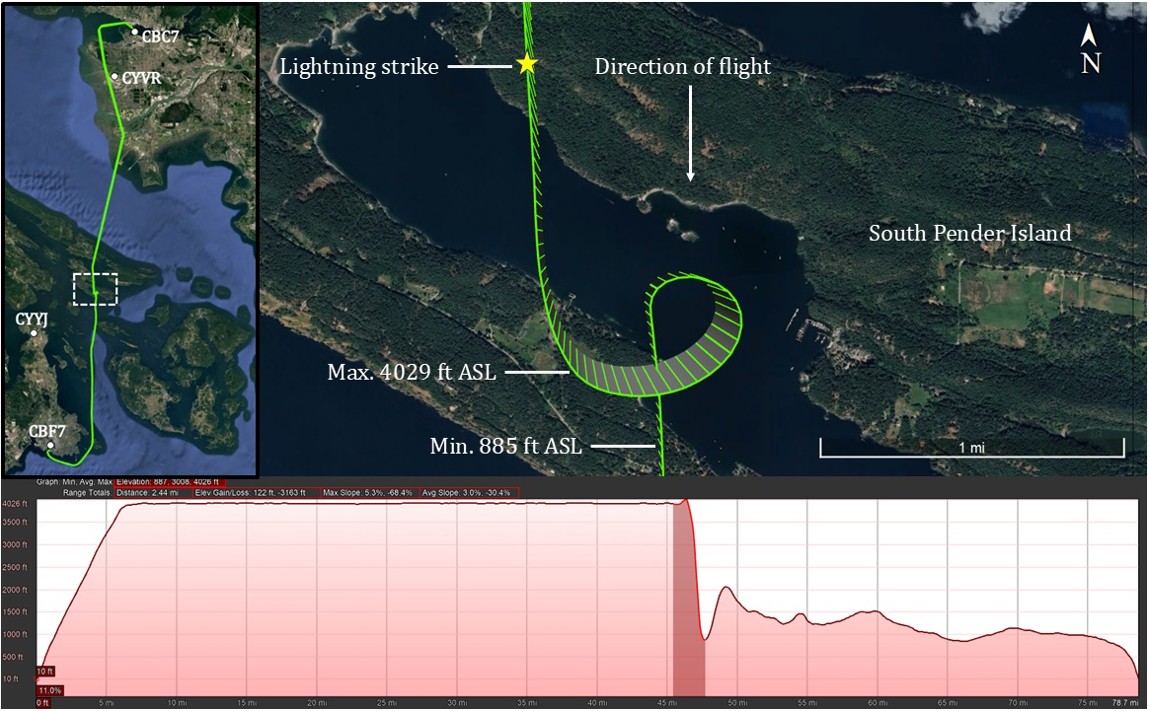
At 0930:21, the helicopter entered an uncontrolled rapid descent from 4029 feet to 885 feet ASL in 36 seconds, reaching a maximum of 63° left roll and 44° pitch down (Figure 1). As the helicopter emerged from the clouds, the captain regained visual reference to the ground and was able to reduce the helicopter’s roll angle and stop the descent. The vertical acceleration peaked at 2.48gg is a unit of measurement of the force resulting from vertical acceleration due to gravity. An acceleration of 1g is 9.8 m/s². before the helicopter climbed back up to 2073 feet ASL.
The FO declared a PAN PAN with Victoria Terminal ATC and asked for vectors to CYYJ to divert to this airport.
The flight crew cancelled the diversion to CYYJ and the associated IFR flight plan and continued under VFR to CBF7 at approximately 1300 feet ASL. Both autopilots were manually re-engaged at 0933:36.
The captain made a short announcement to the passengers informing them that there had been a lightning strike and that the flight crew was now in control and continuing to the destination. Just before arriving at their destination, the captain passed control back to the FO and the helicopter was landed safely at CBF7.
After landing at 0944, the captain once again briefed the passengers on the details of the lightning strike and the passengers disembarked.
1.2 Injuries to persons
There were 2 flight crew members and 12 passengers on board. There were no injuries.
1.3 Damage to aircraft
The helicopter was substantially damaged. One tail rotor blade assembly separated from the helicopter in flight and contacted 3 main rotor blades, the left horizontal stabilizer, the left side of the tail boom, and the left engine cowl.
1.4 Other damage
There was no other damage.
1.5 Personnel information
The flight crew held the appropriate licences and ratings for the flight in accordance with existing regulations.
The captain had started working for Helijet in December 2021 as an FO and was promoted to captain in April 2023. He had completed a pilot proficiency check and his annual recurrent flight training in the Sikorsky S-76C++ Level D full flight simulator on 17 December 2022.
The FO started with Helijet in July 2019 as a ground crew member. He completed the company indoctrination and ground training requirements before he transitioned to piloting in April 2023. The FO successfully completed his flight training and pilot proficiency check in the flight simulator on 12 April 2023. The FO then completed his 1st scheduled company flight 10 days later.
The pilots received training on and were qualified to occupy either the left or right cockpit seat. During their flight training in the simulator, both pilots had completed exercises for unusual attitude recovery, partial panel, and failure of the EFIS displays. The simulator training did not include an emergency related to a lightning strike.
Captain | First officer | |
|---|---|---|
Pilot licence | Airline transport pilot licence – helicopter (ATPL-H) | Commercial pilot licence– helicopter (CPL-H) |
Medical expiry date | 01 June 2024 | 01 November 2024 |
Total flying hours | 9070 | 579.7 |
Flight hours on type | 790 | 336.2 |
Flight hours in the 24 hours before the occurrence | 2.1 | 2.1 |
Flight hours in the 7 days before the occurrence | 10.4 | 17.5 |
Flight hours in the 30 days before the occurrence | 22.4 | 59.9 |
Flight hours in the 90 days before the occurrence | 92.2 | 157.7 |
Flight hours on type in the 90 days before the occurrence | 92.2 | 157.7 |
Hours on duty before the occurrence | 4.25 | 4.25 |
Hours off duty before the work period | 38.2 | 16.7 |
1.6 Aircraft information
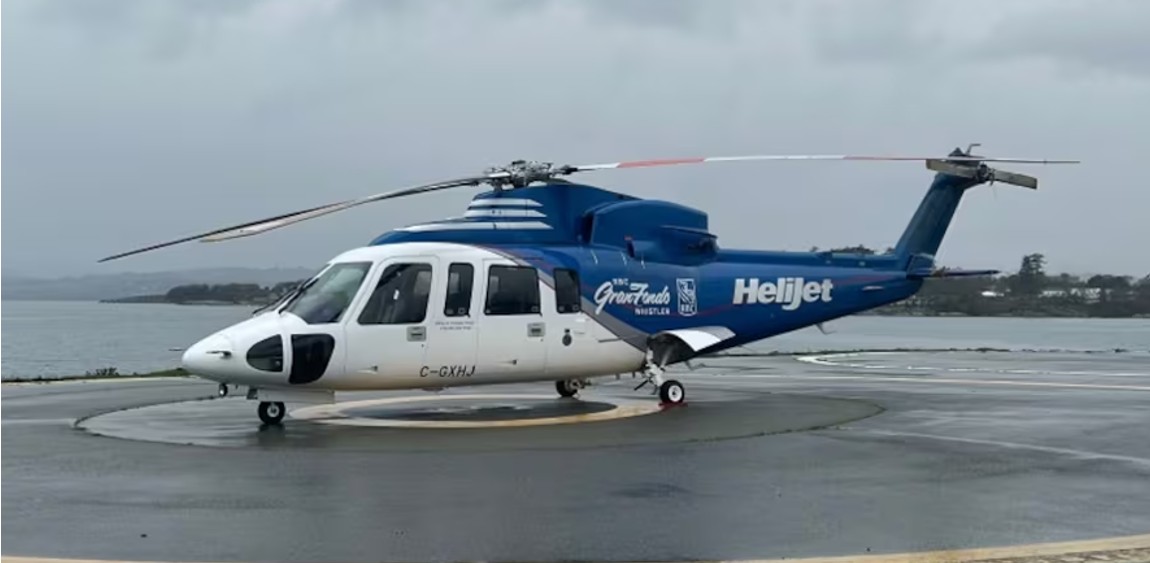
The occurrence Sikorsky S-76C++ helicopter (Figure 2) was powered by 2 Turbomeca Arriel 2S2 turboshaft engines and was configured for 2 pilots and the transport of 12 passengers with 3 rows of 4 seats in the cabin. It was equipped for IFR flight and had a weather radar mounted in the nose of the helicopter with a radar display in the cockpit. The helicopter also had an emergency flotation system that consisted of 2 pop-out floats next to the nose wheel and 1 pop-out float in each main landing gear wheel well. The system can be activated in the case of ditching and increases the time available for the occupants to egress.
The helicopter was type certified by the U.S. Federal Aviation Administration (FAA) and was maintained under a Transport Canada (TC) maintenance schedule approval. After the last flight on 23 October 2023, records indicate that an aircraft maintenance engineer conducted a scheduled airframe and engine inspection and completed a post- and pre-flight inspection.
The tail rotor blade assemblies were installed on the occurrence helicopter on 08 June 2023 following the completion of the 500-hour, 1500-hour, and 3000-hour inspections. The 3000-hour inspection is a non-destructive ultrasonic inspection of the graphite spars. The tail rotor blade assemblies had accumulated approximately 440 flight hours since the inspections.
There were no recorded defects outstanding at the time of the occurrence. There was no indication that a component or system malfunction played a role in this occurrence.
The helicopter’s weight and centre of gravity were within the prescribed limits.
Manufacturer | Keystone Helicopter Corporation, a Licensee of Sikorsky Aircraft Corporation |
|---|---|
Type, model, and registration | Helicopter, S-76C++, C-GXHJ |
Year of manufacture | 2007 |
Serial number | 760774 |
Certificate of airworthiness issue date | 12 June 2023 |
Total airframe time | 3118.1 hours |
Engine type (number of engines) | Turbomeca Arriel 2S2 (2)* |
Rotor type (number of rotor blades) | Fully articulated (4) |
Maximum allowable take-off weight | 11 700 lb (5307 kg) |
Recommended fuel types | Jet A, Jet A-1, Jet B |
Fuel type used | Jet A |
* Safran Helicopter Engines currently holds the type certificate for the engine type.
1.6.1 Main rotor and tail rotor
The occurrence helicopter had 4-bladed main rotor and tail rotor systems.
The 4 main rotor blades consist of a titanium spar with a fibreglass and honeycomb construction and a Kevlar tip cap. A nickel strip covers the outboard section of the leading edge for abrasion protection. Four bolts attach the blade root to the spindle assembly, which is then bolted to the main rotor hub through the elastomeric bearing.
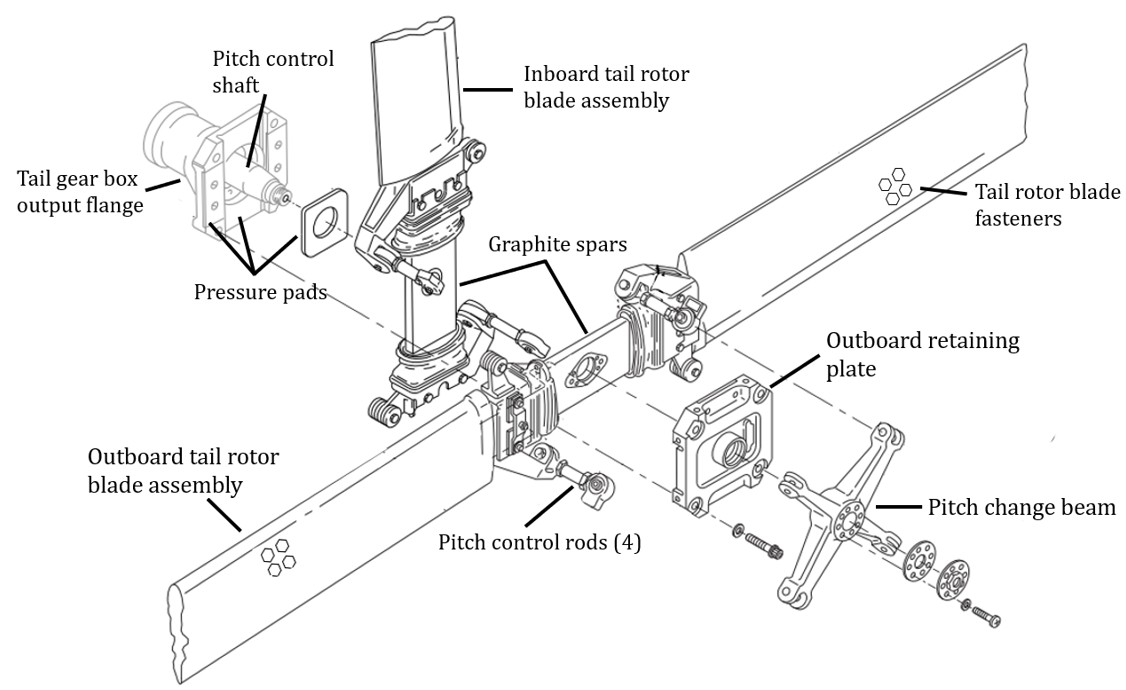
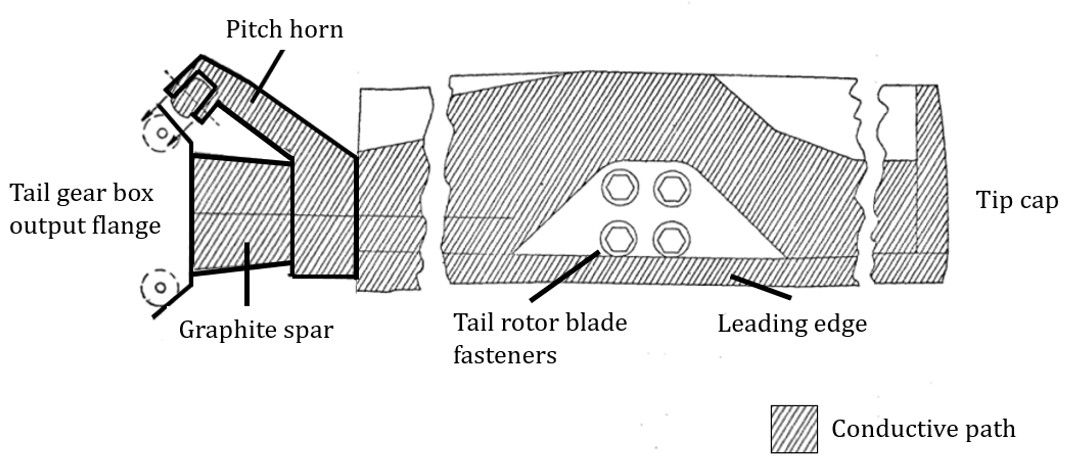
The 4-bladed tail rotor consists of 2 tail rotor blade assemblies stacked on top of each other and clamped between the outboard retaining plate and the tail gear box output flange (Figure 3). Each tail rotor blade assembly consists of 2 opposing tail rotor blades, which are mounted to 1 graphite spar. The tail rotor blades are constructed of graphite and fibreglass with an aluminum pitch horn for the pitch control rods. The rods connect the blades to the pitch change beam and pitch control shaft to form part of the pitch control system for pilot inputs. The blades are attached to the spar with 4 fasteners.
1.6.1.1 Lightning strike protection
The main and tail rotor blades on the occurrence helicopter are constructed of metallic and non-metallic materials and have been identified as a likely attachment pointThe attachment point is the location where the lightning strike enters the aircraft. for the 1st strokeA lightning strike is usually made up of multiple strokes of lightning. in a lightning strike.Federal Aviation Administration (FAA), DOT/FAA/TC-22/11, Lightning Protection of Aircraft Handbook: Final Report (November 2022), chapter 5, section 5.5.5: Zoning and Application of the Current Components, Zoning of rotorcraft, p. 122. As a result, the manufacturer integrated aluminum wire fabric into the blade construction so that the fabric will conduct a portion of the lightning current instead of the underlying blade structure.Sikorsky Aircraft Corporation, Document number SER-760226, Lightning Protection for the S-76 Helicopter, revision B (26 August 1985), section 4.0: Protection Methods, p. 2. According to the FAA Lightning Protection of Aircraft Handbook, woven wire fabrics have effective electrical conductivity and arc root dispersion protection. The fabric’s uneven surface provides lightning with multiple attach points in the blade skin, which disperses the strike’s energy and reduces the physical effects at any individual location.Federal Aviation Administration (FAA), DOT/FAA/TC-22/11, Lightning Protection of Aircraft Handbook: Final Report (November 2022), chapter 6, section 6.2.4: Protection with Conductive Coatings, Woven wire fabrics (WWFs), p. 158.
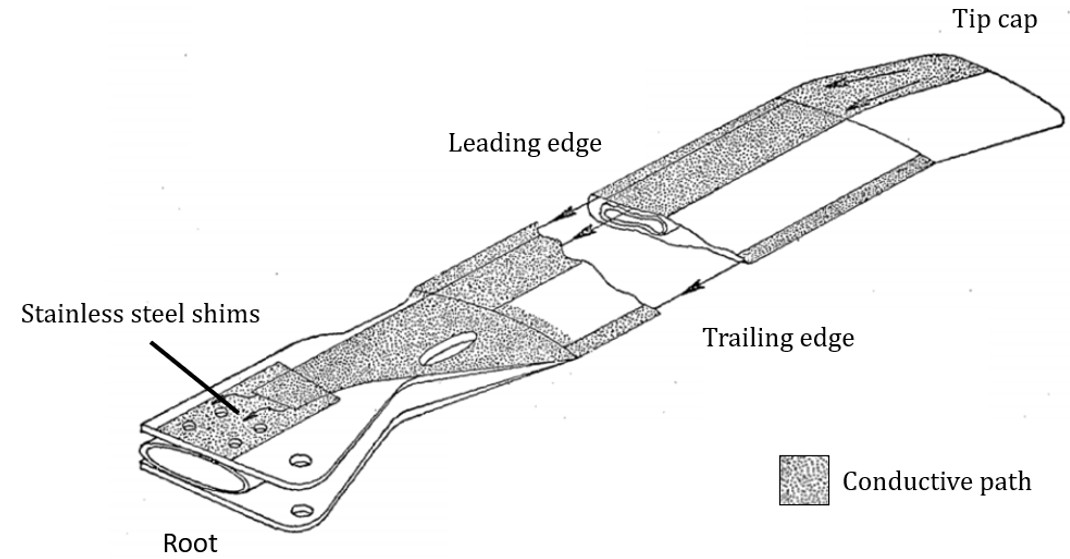
On the main rotor blades, the wire fabric is built into the non-conductive portions of the composite blade structure at different locations along its length (Figure 4). The fabric combines with the nickel leading edge to provide a conductive path from the tip cap to the stainless steel shims that are on the surface of the blade root.Sikorsky Aircraft Corporation, Document number SER-760226, Lightning Protection for the S-76 Helicopter, revision B (26 August 1985), section 4.1: Main Rotor Blades, p. 2. When the blade is installed, the stainless steel shims interface with the spindle assembly that transfers the charge onwards to the helicopter’s main rotor hub, main transmission, and fuselage where the current intensity is dispersed.
The main rotor blade design and construction were similar to a prototype military helicopter rotor blade that had been previously tested for lightning strike protection.Ibid. As a result, the manufacturer applied the test results of the military prototype to the Sikorsky S-76 main rotor blades and did not conduct further lightning protection testing.
The tail rotor blades similarly use the aluminum wire fabric in the blade skin and tip cap to allow the lightning strike charge to transfer to the pitch horn and tail gear box output flange and onwards to the tail gear box and fuselage. To prevent damage to the graphite spar, the fabric remains separated from the tail rotor blade fasteners that attach the spar to the blade and an insulating cover is applied over the blade fasteners (Figure 5). The inboard section of the spar is also protected with an aluminum wire fabric coating that transfers any flashover from the blade root to the output flange.Ibid., p. 3 and p. 4.
The manufacturer conducted lightning protection testing on 3 tail rotor blade assemblies using the 200 kA peak current amplitude specification set by the U.S. Department of DefenseU.S. Department of Defence, Military Specification: Bonding, Electrical, and Lightning Protection, for Aerospace Systems, MIL-B-5087B(ASG) (15 October 1964), section 3.3.4.5: Lightning protection tests, p. 17. and the Society of Automotive Engineers (SAE).Sikorsky Aircraft Corporation, Document number SER-760218, S-76 Tail Rotor Lightning Test (13 September 1978), section 2.0: Summary, paragraph A.): Lightning Test Requirements, p. 2. The separate assemblies each consisted of a single tail rotor blade and spar that was attached to an off-aircraft tail gear box output flange, outboard retaining plate, pitch change beam, and a pitch control rod.McDonnell Aircraft Company, Report number MDC A5549, Final Report: Lightning Tests on Sikorsky S-76 Tail Rotor (01 September 1978), section 2.0: Description of Test Specimens, p. 2. Following the simulated lightning strike, the manufacturer conducted static load tests and analyzed the aerodynamic effects on the blade assembly that had sustained the most damage. It was concluded that the assembly can survive a severe lightning strike and maintain operational capability.Sikorsky Aircraft Corporation, Document number SER-760218, S-76 Tail Rotor Lightning Test (13 September 1978), section 10.0: Conclusion, p. 32.
The FAA adopted lightning protection requirements for transport category rotorcraft in November 1984, which was 6 years after the manufacturer had conducted the tail rotor testing and had received its FAA type certificate approval for the helicopter design. The FAA retained the testing standard peak current amplitude of 200 kA set by the SAEFederal Aviation Administration (FAA), Advisory Circular (AC) 20-155A: Industry Documents To Support Aircraft Lightning Protection Certification (16 July 2013), section 1. Purpose, p. 1, at https://www.faa.gov/regulations_policies/advisory_circulars/index.cfm/go/document.information/documentID/1021588 (last accessed 16 April 2026). with the expectation that approximately 99.5% of all lightning strikes will occur below this threshold.Federal Aviation Administration (FAA), DOT/FAA/TC-22/11, Lightning Protection of Aircraft Handbook: Final Report (November 2022), chapter 5, section 5.5.3: SAE/EUROCAE Lightning Committees, Current components A, B, C and D, p. 108.,Ibid., chapter 2, section 2.6: Summary of Data by Aircraft Lightning Standards Committees, Table 2.2: Parameters for Positive Lightning Flashes Measured at Ground [2.27], p. 40. As an alternative to physical testing, an applicant can also prove lightning protection design to the FAA if it can demonstrate that the design is similar to existing designs that have been incorporated in a previously certified aircraft.Ibid., chapter 5, section 5.2: FAA Lightning Protection Regulations: Regulations and Advisory Circulars (ACs), p. 101.
1.6.2 Digital automatic flight control system
The helicopter’s digital automatic flight control system consists of 2 independent flight control computers that each contain an autopilot and a flight director function. The autopilot and flight director control the helicopter in 4-axis flight (pitch, roll, yaw, and collective), and when the 2 systems are coupled, they automatically control the flight path that is selected by the pilot. In normal operations, both autopilots are on, but only 1 flight director can operate at a time; while 1 actively steers the aircraft, the 2nd is in standby mode. Flight director operation is inhibited if only 1 autopilot is on.
When turned on, the autopilot has a stability augmentation system (SAS) mode and an attitude retention (ATT) mode. The SAS mode is normally used when the pilot is flying manually and it provides “short-term rate damping to reduce pilot workload and improve basic aircraft handling qualities.”Sikorsky Aircraft Corporation, SA 4047-76C-15, Rotorcraft Flight Manual Model S-76C++ Part 2, Revision 9 (15 August 2011), section I, Systems Descriptions, SAS (Stability Augmentation System), p. 1-67. With the SAS mode engaged, the ATT mode can be turned on to maintain the helicopter attitude at the time of activation. The trim system on the cyclic and collective then allows the pilot to set a new helicopter attitude by pressing and holding the trim release button for the respective control, moving the control to set the new attitude, and then releasing the button.
According to Helijet SOPs, the flight director is normally coupled during the departure, climb, cruise, descent, and approach phases of flight, whereas the helicopter is hand flown during take off or landing, or anytime the pilot flying would prefer to hand fly.Helijet International Inc., Standard Operating Procedures: Scheduled Airline Service, Sikorsky 76C++, revision 1.1 (30 September 2020), chapter 1: General, section 1.20.2: Coupled Autopilot, p. 1-25.
During the occurrence flight, the flight director and autopilots had been coupled until the momentary power loss from the lightning strike turned off both the flight director and autopilots. As a result, the FO was immediately tasked with controlling the helicopter in instrument meteorological conditions (IMC) without SAS or ATT modes to assist. The flight crew attempted to reactivate the autopilots during the rapid descent, but both autopilots were not engaged until approximately 3.5 minutes following the lightning strike after the helicopter had already regained level flight.
1.6.3 Flight control hydraulic systems
The 2 independent hydraulic systems functioned normally during the occurrence. As a result, hydraulic pressure was sustained for the main rotor and tail rotor flight controls, and the input control forces for the pilot remained normal despite the extreme flight attitudes.
1.7 Meteorological information
1.7.1 Forecasted weather
The occurrence flight departed CBC7 at 0911. The most recent GFAs issued for the area were at 0429. The reports forecasted that at 0500, a low-pressure centre with an upper trough would be moving south-southeast across Vancouver Island. The forecast in the vicinity of North and South Pender islands called for localized light rain and mist with reduced visibility to 5 statute miles (SM) and ceilings of 1500 feet above ground level (AGL). Otherwise, the forecast indicated a broken ceiling at 5000 feet ASL and a broken cloud layer at 12 000 feet ASL.
As the low-pressure system continued moving across the southern part of Vancouver Island, the GFAs forecasted that 6 hours later, at 1100, the same area would be subject to occasional towering cumulus clouds and altocumulus castellanus with tops at 20 000 feet ASL and reduced visibility to 2 SM with moderate rain showers and mist. In addition, the forecast indicated that the southwestern and southern sections of the island would be subject to isolated cumulonimbus clouds with tops at 24 000 feet ASL and reduced visibility to 1 SM with moderate thunderstorms, rain, mist, and winds gusting to 35 knots.
CYYJ is the closest weather reporting station to the occurrence site for which a TAF is produced. The 24-hour TAF for CYYJ was issued at 0442 on 24 October 2023. The TAF forecasted the following conditions at 0900:
- Winds from 120° true (T) at 10 knots, gusting to 20 knots
- Visibility of 6 SM in light rain and mist
- Scattered cloud layer at 1200 feet AGL and overcast ceiling at 2500 feet AGL
From 0900 to 1400, there would be the following temporary changes to the prevailing conditions:
- Visibility of 2½ SM in moderate rain showers and mist
- Broken ceiling at 1200 feet AGL
Furthermore, the TAF indicated a 30% probability for the following conditions during the same timeframe:
- Visibility of 1½ SM in moderate rain showers and mist
At 0950, an amendment to the TAF was issued following temporary changes to the prevailing conditions from 0900 to 1100:
- Visibility of 5 SM in thunderstorm and rain showers
- Broken ceiling at 2000 feet AGL and overcast cloud layer at 6000 feet AGL with cumulonimbus clouds
As well, the 24-hour TAF for nearby CYVR was issued at 0740 and forecasted light rain with no indication of thunderstorms at the time of the occurrence.
1.7.2 Actual weather
Table 3 lists the METAR for the closest weather reporting station to the occurrence site, CYYJ, issued at 0900 with 2 aerodrome special meteorological reports (SPECIs) issued at 0934 and 0939.
Observation | 0900 | 0934 | 0939 |
|---|---|---|---|
Wind speed | 2 knots | 3 knots | 4 knots |
Wind direction | Variable | 90° true, 20° to 100° variable | 70° true |
Visibility | 15 SM | 15 SM | 15 SM |
Sky conditions |
|
|
|
Temperature / dew point | 7 °C/7 °C | 7 °C/7 °C | 7 °C/7 °C |
Altimeter setting | 29.91 inches of mercury | 29.91 inches of mercury | 29.90 inches of mercury |
In addition to the METARs and their own weather observations, the flight crew had received a pilot weather report (PIREP) during their 1st flight to CBF7. The report was from another Helijet flight crew flying on the same route but in the opposite direction. That flight crew reported that they were cruising at 5000 feet ASL through a few clouds and the outside air temperature was approximately 0 °C with no visible icing. Neither flight crew observed active weather that significantly deviated from the reported and forecasted weather. Furthermore, neither the ATC nor the flight service station (FSS) at Victoria Harbour Water Aerodrome (CYWH) were aware of thunderstorm or lightning activity in the area that morning and they did not receive any PIREPs that indicated otherwise.
Once the flight crew regained controlled and level flight after the lightning strike, they continued the flight to CBF7 and flew below the clouds in VFR conditions until they landed. The METAR for CYWH, the closest weather reporting station to their destination, reported the following conditions at 0900:
- Winds from 130°T at 8 knots
- Visibility of 15 SM
- Few clouds at 2500 feet AGL and overcast ceiling at 10 000 feet AGL
- Temperature 9 °C and dew point 7 °C
- Altimeter setting 29.91 inches of mercury
At 1000, the reported winds increased to 10 knots with a broken ceiling at 1000 feet AGL and an overcast cloud layer at 6000 feet AGL.
The CYYJ TAF and METAR were updated after the occurrence.
1.7.3 Environment and Climate Change Canada analysis
The investigation requested from Environment and Climate Change Canada an analysis of the weather conditions affecting the South Pender Island area at the time of the occurrence.
The meteorological assessmentEnvironment and Climate Change Canada, Meteorological Service of Canada, Meteorological Assessment October 24, 2023: South Pender Island, British Columbia (12 March 2024). determined that a low-pressure centre was west of Cape Scott at the northern tip of Vancouver Island at 0500 with a warm front that extended to the southeast across the island and was moving south-southeast at approximately 20 knots. In addition, there was a low-pressure trough that extended both to the north and to the southeast of the low.
A weather radar installation, located approximately 34 NM north-northeast of the occurrence site in Aldergrove, captured images that showed a large area of precipitation across southern Vancouver Island and the surrounding waters. The precipitation varied in intensity with localized heavy rain that extended over South Pender Island at approximately 0929 and indicated an intense area of convection.
Cumulonimbus clouds, in which thunderstorms develop, typically extend high into the atmosphere and are easily identified. Satellite imagery over the southern part of Vancouver Island and the Georgia Strait showed abundant cloud cover that had a consistent level of white colour and lacked any texture or clouds protruding above the cloud layer. In addition, radar echo top imagery showed small variations in the heights of convective cloud in the area with tops from 13 000 to 15 000 feet AGL. Based on the relative uniformity of the cloud tops seen in the images, the low-topped cumulonimbus cloud that produced lightning was not readily identifiable and it was likely embedded in the wider cloud layer in an area of more intense rain showers.
The upper air sounding at Port Hardy was likely representative of the conditions over South Pender Island while the air mass was moving south across Vancouver Island. The sounding at 0500 showed significant depth of air near saturation from 2500 feet to 18 000 feet ASL and instability above 5000 feet ASL that indicated the likely development of embedded convection. Winds below 18 000 feet ASL were light, and the freezing level was approximately 2500 feet ASL with decreasing temperatures above that altitude.
1.7.3.1 Lightning strikes
Cloud-to-ground lightning typically originates in a cloud and lowers a positive or negative electrical charge to the earth in the form of a stepped leader. The leader establishes an ionized channel in the atmosphere that allows the opposite electrical charge to flow from the ground and meet the leader to form a lightning stroke.Federal Aviation Administration (FAA), DOT/FAA/TC-22/11, Lightning Protection of Aircraft Handbook: Final Report (November 2022), chapter 2, section 2.2.4: Transition from Leader to Stroke, p. 24 and section 2.2.8: Lightning Polarity and Direction, p. 31. The originating electrical charge in the cloud determines whether the lightning strike is positive or negative.
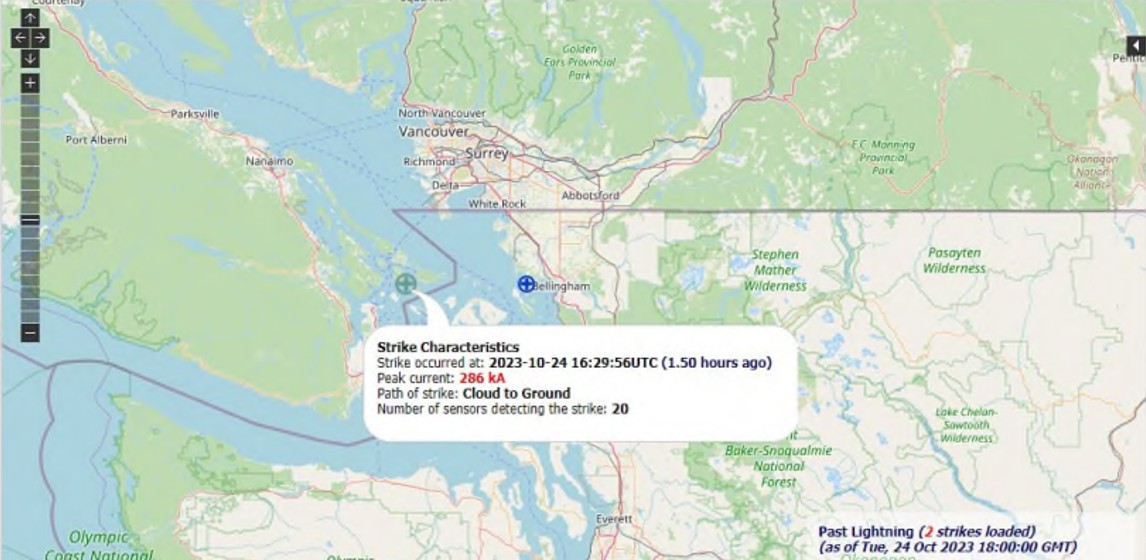
The Canadian Lightning Detection Network (CLDN) detected 6 lightning strikes on the morning of the occurrence; 4 strikes were to the west of Vancouver Island at approximately 0630 and then 2 strikes were east of the island in the southern Georgia Strait at approximately 0830 and 0930. The latter 2 strikes in the Georgia Strait were both isolated and positive cloud-to-ground strikes.
Positive cloud-to-ground lightning strikes comprise approximately 10% of all lightning strikes. They originate from areas of high positive charge that are mostly found near the top of the cloud, but pockets of high positive charge can also be found near the base of the cloud.Ibid., chapter 2, section 2.2.1: Generation of the Charge, p. 21 and section 2.2.8: Lightning Polarity and Direction, Positive flashes, p. 31. In comparison to negative strikes, the peak current of the positive cloud-to-ground lightning strike is significantly higher, lasts longer, and can occur several miles away from precipitation. Positive cloud-to-ground lightning strikes are typically 1 stroke of lightning and aircraft have “experienced unusually extensive physical damage from positive flashes.”Ibid., chapter 2, section 2.2.8: Lightning Polarity and Direction, Positive flashes, p. 31.
The strike detected by the CLDN at 0929:56 over South Pender Island struck the occurrence helicopter while it was cruising at approximately 3930 feet ASL. The strike was recorded with a peak current of 286 kA that had a maximum rate-of-riseThe rate-of-rise of lightning is the rate of change in electrical current from the time the stroke starts to the time the peak current is attained. of 161.5 kA per microsecond (Figure 6).
1.7.3.2 Helicopter-induced lightning
Helicopter-induced lightning is a phenomenon in which the helicopter triggers a lightning strike; it often occurs in areas where there is little natural lightning activity.Royal Meteorological Society, Investigation and prediction of helicopter-triggered lightning over the North Sea (30 March 2012), section 1: Introduction, p. 94. Helicopters, like all aircraft, acquire a negative charge that is created by the frictional contact with the air during flight. The rapidly rotating main rotor and tail rotor blades will generate the greatest concentration of negative charge and are likely an entry point for the initial lightning stroke. When the helicopter encounters a positively charged region of a cloud and the potential difference is great enough between the opposing charges, the helicopter can trigger a positive lightning strike.Ibid., section 3.2: Hypotheses of how triggered lightning strikes occur, pp. 99–100.
The Met Office of the United Kingdom studied the meteorological conditions for helicopter-induced lightning over the North SeaIbid., pp. 94–106. and identified that all of the examined lightning strikes occurred during the winter months when polar air masses move over a warmer sea surface, which can create instabilities that are embedded in cloud layers. The following conditions generate a risk for this type of lightning to occur:
- Flight level static air temperature from −2 °C to −6 °C;
- Freezing level from 1000 feet to 3000 feet ASL; and
- Precipitation rates above 4 mm/h.Environment and Climate Change Canada, Meteorological Service of Canada, Meteorological Assessment October 24, 2023: South Pender Island, British Columbia (12 March 2024), section 3: Aircraft Induced Lightning, p. 20.,Ibid., section 4: Conclusion, p. 22.
Based on the representative upper air sounding in Port Hardy, the freezing level was at approximately 2500 feet ASL and the temperature continued to decrease above that altitude. The temperature where the lightning strike occurred was estimated to be from −2 °C to −6 °C at 3900 feet ASL. In addition, the radar data indicated precipitation rates of 5 mm to 11 mm of rain per hour in the South Pender Island region at 0930.Ibid., section 3: Aircraft Induced Lightning, p. 20.
The Met Office of the United Kingdom and the Norwegian Meteorological Institute have combined meteorological conditions and historical data on helicopter-induced lightning strikes in the North Sea region to develop tools that forecast the risk of helicopter-induced lightning for offshore helicopter operators that fly over that region. There are currently no such tools available in Canada. However, since 1990, there have only been 2 other occurrences of helicopter-induced lightning reported to the TSB. Both occurrences took place on Canada’s East Coast, one in 2014 and the other in 2025.TSB air transportation occurrences A25A0001 and A14A0097.
1.8 Aids to navigation
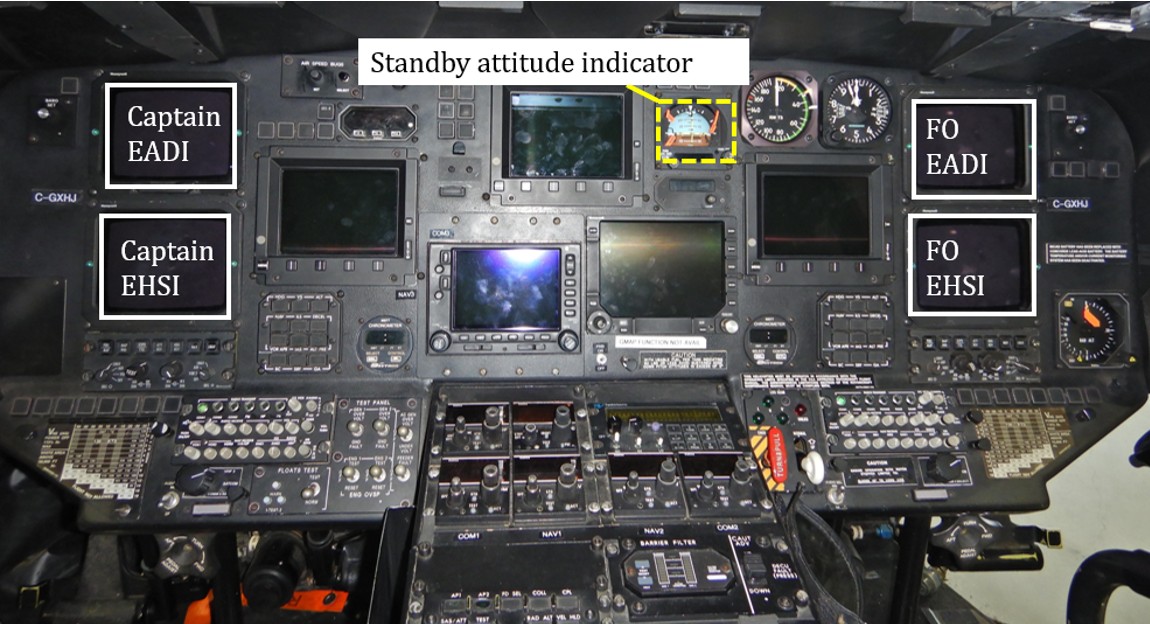
The occurrence helicopter had an integrated EFIS that consisted of 2 electronic displays, both mounted directly in front of each of the left and right cockpit seats. The displays provide an electronic attitude director indicator (EADI) and an electronic horizontal situation indicator (EHSI). During normal operations, the EADI is shown on 1 display and the EHSI is shown on the other. If 1 display fails, the EADI and EHSI information are combined on the remaining display.
If there is a complete failure of all electronic displays, the helicopter has a standby attitude indicator, a standby airspeed indicator, a standby altimeter, and a standby magnetic compass. The standby attitude indicator has an independent battery and is mounted in the upper centre right of the instrument panel. The display is half the size of the EADI display (Figure 7).
The occurrence flight was in IMC and the flight crew relied on the EADI for situational awareness of the helicopter position and the EHSI to navigate to the destination. At the moment of the lightning strike, all electronic displays momentarily went black and did not provide any information. The standby instruments remained operational.
All electronic displays recovered quickly, but the air data computer (ADC) for the right side of the cockpit had failed and the related flight information was no longer valid on those displays. As a result, the FO was reliant on the standby instrumentation for continued flight in IMC until the captain took control.
The helicopter was also equipped with a Honeywell Primus weather radar that provided storm activity by displaying a visual colour gradient for rainfall intensity. According to Helijet procedures, the weather radar “should be on for IFR”Helijet International Inc., Standard Operating Procedures: Scheduled Airline Service, Sikorsky 76C++, revision 1.1 (30 September 2020), chapter 3: Departure, section 3.6: Before Takeoff Check, p. 3-6. and normally set to weather mapping with a maximum range of 25 NMIbid., chapter 4: Cruise, section 4.6.3: Weather Radar, p. 4-3. for navigating through severe weather. The flight crew set up the radar accordingly with a 5° upward tilt.
The captain was monitoring the weather radar, which provided no indication of towering cumulus clouds or heavy precipitation until the helicopter made the left turn onto a magnetic heading of approximately 160° and was approaching North Pender Island. At that point, the captain saw some red indications within the 5 NM range on the display. The red colour indicates 12–50 mm/h of rainfall, but it was also common to see the red colour when the radar antenna scanned the terrain of the islands. Despite entering an area of heavy rainfall and turbulence, the radar did not show any indications of heavy rainfall beyond the 5-NM range, which led the captain to attribute the red colour to the approaching terrain.
The FAA’s Lightning Protection of Aircraft Handbook acknowledges that air radar systems are limited for detecting thunderstorms when electrified cloud regions have minimal liquid rain droplets for radar echoes or when lower flight altitudes display ground clutter that obscures the storm.Federal Aviation Administration (FAA), DOT/FAA/TC-22/11, Lightning Protection of Aircraft Handbook: Final Report (November 2022), chapter 3, section 3.3.4: Thunderstorm Avoidance, Weather radar, p. 52. Furthermore, several aircraft strike incidents have been reported without a thunderstorm being observed visually or detected from a ground- or air-based radar system.Ibid., chapter 3, section 3.3.3: Immediate Environment at Time of Strike, p. 50.
1.9 Communications
The helicopter was flying in controlled airspace for the entirety of the flight.
Shortly after the lightning strike, the flight crew inadvertently triggered the radio communication switch on the cyclic and transmitted cockpit audio to Victoria Terminal ATC while attempting to control the helicopter. Once the helicopter regained level flight, the flight crew declared a PAN PAN and ATC immediately provided nearby traffic information and then directed all traffic clear of the helicopter’s VFR flight path to CBF7.
Victoria Terminal ATC continued to monitor the helicopter until the flight crew was passed off to Harbour radio in Victoria for landing. Victoria Terminal ATC informed Harbour radio that the helicopter’s mode C transponder was no longer providing altitude information and that an altitude of 1300 feet ASL was the last altitude that had been confirmed with the flight crew.
1.10 Aerodrome information
The scheduled destination for the occurrence flight was CBF7. CBF7 is a certified aerodrome privately operated by Pacific Heliport Services, a subsidiary of Helijet International Inc., and is designated for helicopter use only. There are no aircraft rescue and firefighting services on-site.
Following the lightning strike and recovery from the unusual attitude, the captain opted to continue to CBF7, which was approximately 21 NM to the south-southwest. Another option was to fly to CYYJ, which was approximately 10 NM to the west-southwest and has critical category 7The critical category number is published in NAV CANADA’s Canada Flight Supplement by the operator of an aerodrome and corresponds to the level of firefighting services available to respond to an aircraft emergency at an aerodrome. aircraft rescue and firefighting services available from 0500 to 0000.
1.11 Flight recorders
The occurrence helicopter was equipped with a solid-state multipurpose flight recorder (MPFR) that contained both cockpit audio and flight data recordings.
The MPFR had a cockpit audio recording capacity of 120 minutes; its recorded data included the occurrence flight. The cockpit audio data was successfully downloaded and contained good quality audio for the occurrence flight.
The MPFR also contained approximately 78 hours of flight data that covered the occurrence flight. The flight data was successfully downloaded.
The data indicated significant fluctuations in the flight and operational parameters of the helicopter after the lightning strike (Appendix A). During the uncontrolled rapid descent, the recorded main rotor rpm and the pitch and roll angles momentarily exceeded the flight limitations listed in the rotorcraft flight manual (RFM) (Table 4).Sikorsky Aircraft Corporation, SA 4047-76C-15, Rotorcraft Flight Manual Model S-76C Part 1, revision 7 (25 October 2010), section I: Operating Limitations, pp. 1-10 and 1-21.
Flight parameter | RFM limit | Maximum recorded value |
|---|---|---|
Main rotor speed – Power on | 109% | 109.9% |
Roll angle | No aerobatic manoeuvres* | −63.8° |
Pitch angle | No aerobatic manoeuvres* | −44.3° |
* U.S. Federal Aviation Regulation Part 29 does not define aerobatic, but Part 23 section 23.2005 indicates normal category airplanes are certified for only 60° bank or less, Part 91 section 91.303 indicates “aerobatic flight means an intentional maneuver involving an abrupt change in an aircraft’s attitude, an abnormal attitude, or abnormal acceleration, not necessary for normal flight,” and Part 91 section 91.307 indicates that no pilot of an aircraft carrying any person, other than a crewmember, can execute an intentional manoeuvre that exceeds 60° of bank and 30° of pitch unless each occupant is wearing a parachute.
With the loss of 1 tail rotor blade assembly, the tail rotor pedal displacement differed from pre-strike values by approximately 15%, but the pilots were able to maintain directional control during the remaining cruise and landing phases of flight.
The MPFR is connected to the right ADC for air data information. The data confirmed that the right ADC failed immediately after the lightning strike and resulted in the loss of recorded pressure altitude, computed airspeed, vertical speed, and outside air temperature.
The helicopter was also equipped with a SKYTRAC ISAT-200A tracker (ISAT) that used the global positioning system (GPS) and the Iridium Satellite constellation to transmit the helicopter position, speed, and direction. The ISAT was sent to the TSB Engineering Laboratory in Ottawa, Ontario, where the data files were successfully recovered and synchronized with the MPFR flight and audio data to produce a reconstructed flight path for investigative analysis.
The helicopter was also equipped with a Honeywell EVXP health usage and monitoring system (HUMS), which monitors and records helicopter vibrations and exceedances to determine the health of operational components.
The HUMS data indicated a momentary vibrational peak in 3 tail rotor parameters during the occurrence flight that were not consistent with previous operations. The increased vibration can most commonly result from a change in the rotating centre of mass in the plane of rotation, a split track between pairs of tail rotor blades, or loose components in the tail rotor system.Honeywell International Inc., EVXP Health Monitoring System: Diagnostic Manual For the S-76C++ Aircraft After S/N 760511 (21 January 2011), section 4: Recommendations for Monitor Advisories, Condition Indicator: T/R 1P (Channel 32B-TR FA), Condition Indicator: T/R 2P (Channel 32B-TR FA), and Condition Indicator: T/R 4P (Channel 32B-TR FA).
The date and time parameters on the HUMS can be manually set. As a result, the investigation was unable to determine the precise time of the vibration peaks, but it noted that the increased vibration was not sustained.
The HUMS data did not indicate any significant changes in the main rotor vibrations.
1.12 Wreckage and impact information
Following the lightning strike, the flight crew evaluated the helicopter systems in level flight and did not detect any significant defects that would preclude safe flight to the intended destination. The helicopter landed at CBF7 with no further issue.
During the post-flight inspection, the flight crew found that 1 tail rotor blade assembly had separated from the helicopter and that there was damage to the left side of the horizontal stabilizer and the left side of the engine cowl. Helijet maintenance was notified and dispatched to CBF7. The helicopter was removed from service, disassembled, and transported by truck back to the Helijet hangar at CYVR.
TSB investigators conducted a search on South Pender Island for the missing tail rotor blade assembly, but they were unable to find it or any associated fragments.
1.12.1 Tail rotor examination
The inboard tail rotor blade assembly had separated from the helicopter, and the spar centring plug was all that remained with the helicopter. For each of the separated rotor blades, the pitch control rod end assembly had fractured in overload at the blade attachment point and the bonding jumper was broken during separation (Figure 8). The opposite end of the pitch control rods remained attached to the helicopter and 1 bearing surface had damage that was consistent with flashover.
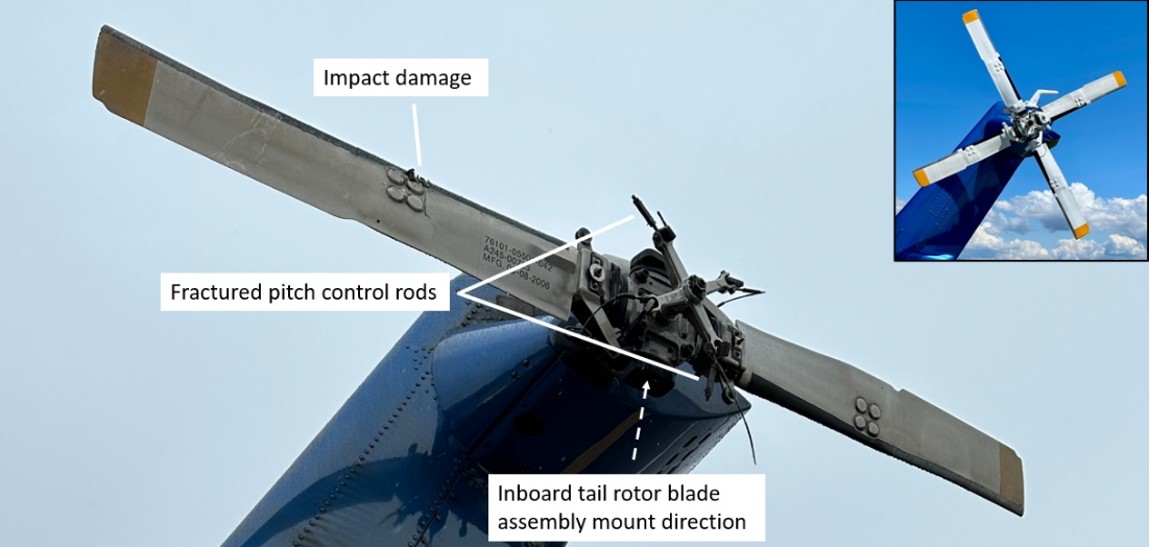
The outboard tail rotor blade assembly remained attached to the tail rotor output shaft by the outboard retaining plate. One tail rotor blade had impact damage to the leading edge near the tail rotor blade fasteners. The same rotor blade had minor pitting on the leading edge approximately ¾ inch from the tip, which is consistent with lightning attachment. The other rotor blade of the assembly was not damaged.
1.12.2 Tail rotor drive examination
The tail gear box operated normally and had no indication of flashover between the gear box mounting pads and the fuselage. In addition, there was no sign of flashover between the pitch control shaft and the tail gear box output shaft.
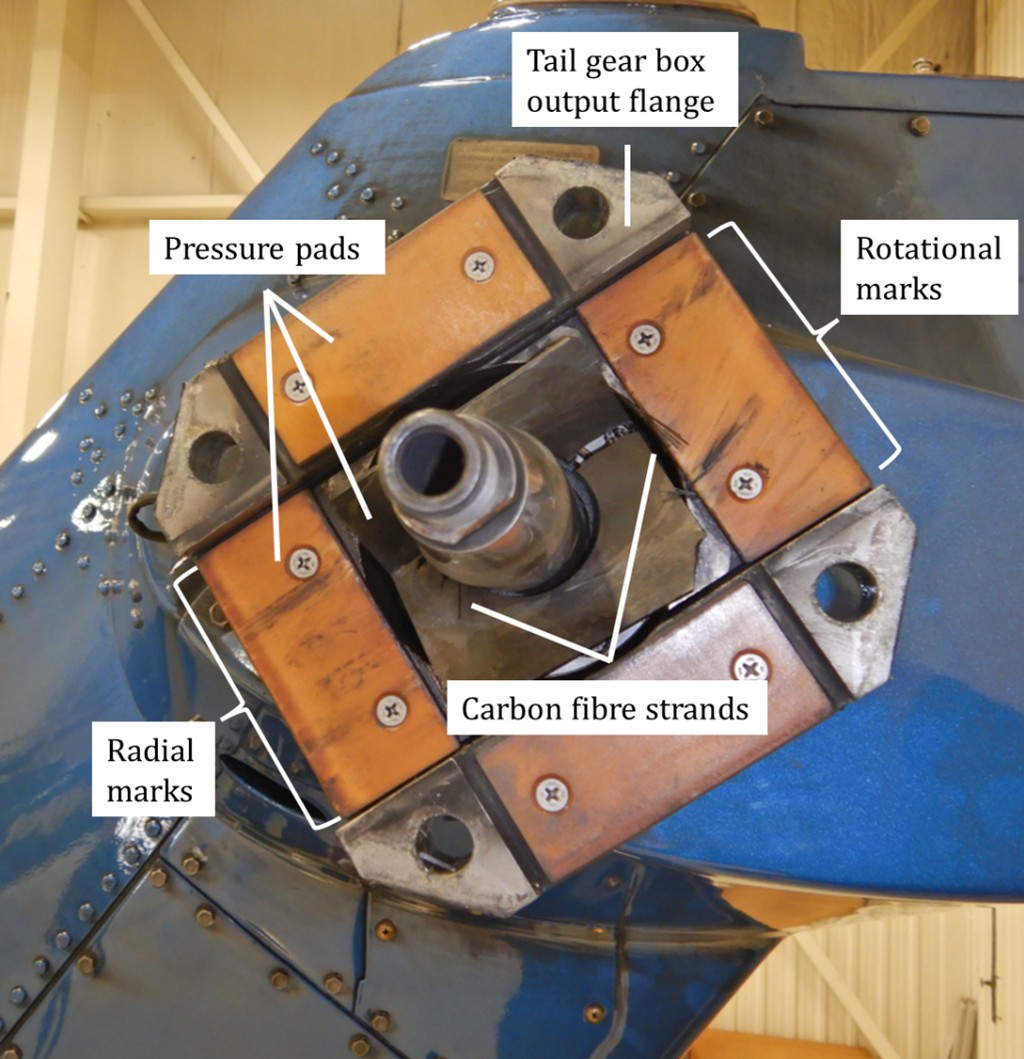
The pressure pads on the tail gear box output flange had radial and rotational marks where the inboard tail rotor blade assembly was mounted (Figure 9). One pressure pad had carbon fibre strands embedded in the pad. In addition, the pressure pad surrounding the pitch control shaft was broken in half with carbon fibre strands present.
The tail rotor drive shaft between the tail gear box and the intermediate gear box did not exhibit any sign of flashover between the connecting flanges of any component.
1.12.3 Main rotor blade examination
Each of the 4 main rotor blades is assigned a colour-coded name (red, blue, yellow, black) based on where they are installed on the main rotor hub.
The occurrence helicopter’s blue main rotor blade had burn marks on both sides of the tip cap that exposed the underlying Kevlar skin. The tip cap’s leading-edge abrasion strip had buckled slightly on the upper (Figure 10) and lower aft edge as well as on the lower aft edge at the overlapping outboard seam, which is consistent with lightning attachment. The tip cap attachment doubler had buckled on the upper and lower skins.
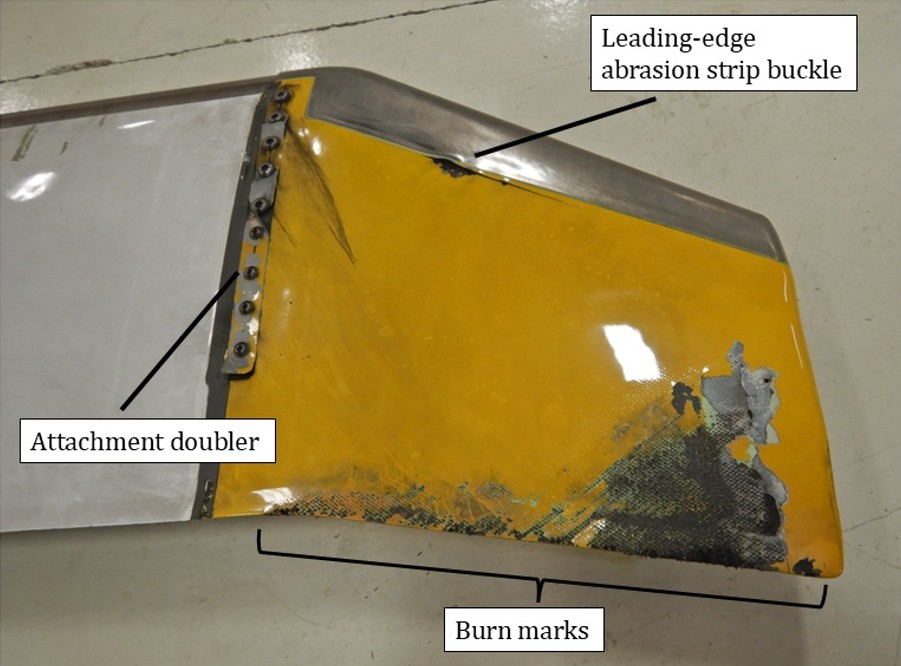
In addition, the blue main rotor blade’s upper and lower skin had burn marks down the length of the blade that were characterized by paint blisters in a mesh pattern, which is consistent with the arc root dispersion of the wire fabric.Federal Aviation Administration (FAA), DOT/FAA/TC-22/11, Lightning Protection of Aircraft Handbook: Final Report (November 2022), chapter 6, section 6.2.4: Protection with Conductive Coatings, Woven wire fabrics (WWFs), p. 158. At approximately 98 inches from the blade root, the lower skin had minor paint chips and abrasion marks likely from a glancing impact with an object.
The table below summarizes the varying degrees of damage on the 4 main rotor blades (Table 5).
Colour designation | Serial number | Observed damage |
|---|---|---|
Red | A086-02438 | Minor lower skin impact damage located approximately 136 inches from the blade root and measuring 1.7 inches in length |
Blue | A086-03582 | Minor lower skin paint chips and abrasion marks located approximately 98 inches from the blade root. Burn marks on both the upper and lower skins down the length of the blade and on the tip cap. Buckling of the aft edge of the leading-edge abrasion strip at the tip cap and overlapping outboard seam. Buckling of the upper and lower tip cap attachment doubler. |
Yellow | A086-01636 | Minor leading edge impact damage located approximately 82.5 inches from the blade root |
Black | A086-00842 | No damage |
1.12.4 Main rotor head examination
The blue main rotor blade damper, pitch control rod, and bonding jumper exhibited damage from the lightning strike. The damper inboard and outboard spherical bearings had minor pitting, flaking, and discolouration. The pitch control rod upper and lower spherical bearings and bearing races had significant discolouration with melted material over a portion of the bearing and bearing races (Figure 11).
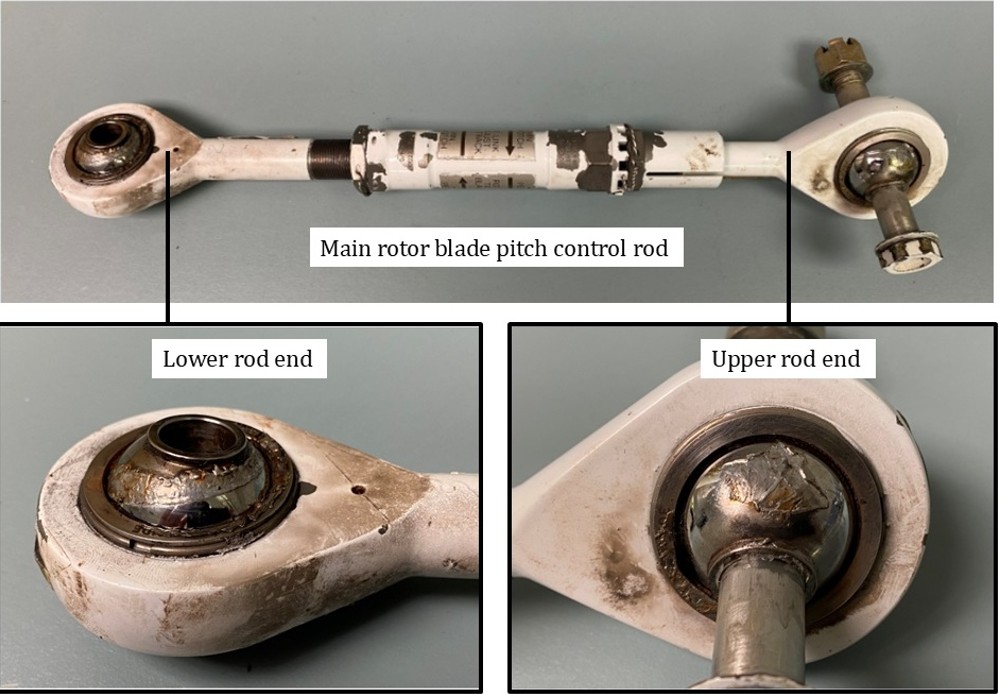
The pitch control rod attachment points at the blade spindle and the swashplate also had indications of flashover.
The bonding jumper between the blade spindle and the main rotor hub was intact, but the plastic outer sheath was melted and partially missing.
1.12.5 Other damage to the helicopter
The engine cowl had localized impact damage with embedded fragments from a tail rotor blade.
The left side of the horizontal stabilizer was missing a semicircular portion of the fibreglass honeycomb leading edge that was approximately 11 inches wide and had extended to the stabilizer spar. The direction of the impact damage was determined to be from the top skin to the bottom skin, which is consistent with a tail rotor blade strike.
The left side of the tail boom had minor scuffs and paint cracks. Carbon fibre splinters were also found embedded in various tail boom decals.
1.13 Medical and pathological information
There was no indication that the flight crew’s performance was negatively affected by medical factors or fatigue.
1.14 Fire
There was no indication of fire either before or after the occurrence.
1.15 Survival aspects
The pilots were not wearing helmets nor were they required to be by regulation.
The pilots and passengers were each wearing a 4-point safety belt, which consisted of a lap strap and a dual shoulder harness that was retained by a single inertia reel.
The passengers each had an available safety features card that contained the required information listed in the regulations.Transport Canada, SOR/96-433, Canadian Aviation Regulations, Standard 724: Commuter Operations – Helicopters, paragraph 724.35: Safety Features Card. Each helicopter occupant had an inflatable life vest mounted under their respective seat. The helicopter also had a first aid kit located beside the right pilot seat and 2 cabin fire extinguishers.
1.16 Tests and research
1.16.1 TSB laboratory reports
The TSB completed the following laboratory reports in support of this investigation:
- LP149/2023 – CVR [cockpit voice recorder] Audio Recovery
- LP150/2023 – NVM [non-volatile memory] Data Recovery – Flight Tracker and HUMS [health and usage monitoring system]
- LP151/2023 – MPFR [multipurpose flight recorder] Recovery, Analysis and Flight Path Reconstruction
1.17 Organizational and management information
Helijet International Inc. is a privately owned company based on the southeast side of CYVR and holds an air operator certificate for operations conducted under Subpart 702 (Aerial Work), Subpart 703 (Air Taxi Operations), and Subpart 704 (Commuter Operations) of the Canadian Aviation Regulations. The company provides scheduled helicopter transportation on the west coast of British Columbia (BC) and a dedicated 24/7 air ambulance service for BC Emergency Health Services. It also provides charter, sightseeing, and utility services throughout BC.
The company’s fleet at the time of the occurrence consisted of 15 Sikorsky S-76 helicopters, 3 Airbus AS350 helicopters, 1 Cessna Citation X airplane, and 1 Learjet 31 airplane.
The company is also a TC-approved maintenance organization with ratings for non-specialized work on their aircraft fleet and additional avionics, dynamic component, and sheet metal structure capabilities.
The company utilizes the TC-certified Sikorsky S-76C++ Level D full flight simulator located at FlightSafety International in West Palm Beach, Florida, United States, for initial, recurrent, and additional pilot training.
1.18 Additional information
1.18.1 Direct and indirect effects of lightning strikes on aircraft
The effects of lightning strikes on aircraft are classified as either direct or indirect. Direct effects address the physical impact that the lightning attachment will have on the aircraft, whereas the indirect effects address the electromagnetic fields and voltage rises that can be induced into aircraft systems by the lightning currents.
In this occurrence, the positive cloud-to-ground lightning strike produced 1 lightning stroke that transferred a large percentage of the charge to the aircraft. The peak current amplitude of the lightning stroke determines the explosive or shock wave effect of the stroke.Federal Aviation Administration (FAA), DOT/FAA/TC-22/11, Lightning Protection of Aircraft Handbook: Final Report (November 2022), chapter 2, section 2.5.2: The Cianos and Pierce Data, Peak Currents, p. 36. In addition, the current amplitude and duration determine the thermal effects of the stroke, which also contribute to physical damage.
The following are the main physical effects that can occur on carbon fibre composites primarily from the current created by the 1st lightning stroke:
- overheating, called ohmic heating, that can melt resins and reduce structural integrity;
- cracking or fracturing of the laminate plies from the shock wave that radiates from the stroke current; and
- delamination of the laminate plies from the outgassing of the resin from overheating or the shock wave.Ibid., chapter 4, section 4.3: Physical Effects on Highly Resistive Structures, Conductive composites, p. 85.
In addition, the combination of composite and metallic materials in the main and tail rotor blades leads to varying conductivity properties at different locations in the blade. As a result, all metallic materials must be electrically bonded to avoid flashover between parts and the resultant damage that can lead to catastrophic failure when under operational loads.
Indirect effects are the result of voltage and current being induced into the aircraft electrical wiring from the changing magnetic fields that are created by a lightning strike while it flows through the airframe.Ibid., chapter 4, section 4.7: Induced Effects, p. 94. The voltage induced into the electrical wiring is directly proportional to the maximum rate-of-rise of the strike—the higher the rate-of-rise, the higher the voltage.Environment and Climate Change Canada (ECCC), Meteorological Service of Canada, email to TSB investigator (05 May 2025). The spikes in voltage can damage all electrical systems, with the solid-state electronic equipment being the most vulnerable because of its normally low operating voltages.Federal Aviation Administration (FAA), DOT/FAA/TC-22/11, Lightning Protection of Aircraft Handbook: Final Report (November 2022), chapter 4, section 4.7: Induced Effects, Aircraft experience, p. 97. The SAE establishes a maximum rate-of-rise of 140 kA per microsecond for lightning protection testing, which represents a severe strike.Ibid., chapter 5, section 5.5.3: SAE/EUROCAE Lightning Committees, Current components A, B, C and D, p. 108 and section 5.5.4: The Standardized Environment, Component A – First Stroke Current, p. 111.
In 2011, the FAA updated the lightning protection requirements for transport category rotorcraft to include electrical systems and electronic equipment because of the increasing integration of electronics into flight-critical systems.
1.18.2 Spatial disorientation
People know the orientation of their body (e.g., lying down, standing, leaning) when they are in physical contact with the ground. However, they are not accustomed to the 3-dimensional environment of flight, and conflicts may arise between the senses and what is perceived, making it difficult or impossible to maintain spatial orientation. Pilot spatial disorientation is defined as the “inability of a pilot to correctly interpret aircraft attitude, altitude or airspeed in relation to the Earth or other points of reference.”Australian Transport Safety Bureau, An overview of spatial disorientation as a factor in aviation accidents and incidents (03 December 2007), Executive Summary, p. vii, at https://www.atsb.gov.au/publications/2007/b20070063 (last accessed on 20 April 2026).
People process information from the following 3 sensory systems to orient themselves in space:
- the visual system,
- the vestibular system (information from the inner ear), and
- the proprioceptive system (information from muscles, joints, and bones).Ibid., chapter 1, section 1.2: The normal process of spatial orientation, p. 4.
The visual system provides 80% of the information used for spatial orientation. If visual information is lost, all that remains is the 20% of information that comes from the vestibular and proprioceptive systems. The information from these 2 systems is less precise and is therefore more prone to illusions and misinterpretation when that information is processed by the brain.Ibid. When visual cues from the ground are poor or non-existent, spatial disorientation can be overcome by referring to flight instruments to control the aircraft’s position.Ibid., chapter 4: Preventive Measures, Training and education, p. 25.
To avoid a loss of control, pilots must be familiar with the mechanisms that lead to spatial disorientation, be aware of the potential for disorientation when visibility and ground references are reduced, and understand how to handle such a situation.Ibid., chapter 4: Preventive Measures, Planning and preparation, p. 23.
The Transport Canada Aeronautical Information Manual (TC AIM) describes the potential for disorientation. It refers to vision as our strongest orienting sense and stresses that when in whiteout or cloud, this sense is not available, which increases the likelihood of disorientation. It provides the following example:
once a turn has been entered and is being maintained at a steady rate, the sensation of turning will disappear. Upon recovering from the turn, pilots may feel as though they are turning in the opposite direction and erroneously re-enter the turn, even causing the aircraft to enter into a spin or spiral.Transport Canada, TP 14371E, Transport Canada Aeronautical Information Manual (TC AIM), AIR – Airmanship (20 March 2025), section 3.7: Disorientation, at https://tc.canada.ca/sites/default/files/2025-03/aim-2025-1_access_e.pdf (last accessed on 20 April 2026).
While the conditions mentioned are whiteout and cloud, a similar absence of external visual cues and resultant disorientation can occur in darkness. Spatial disorientation can lead to loss of control of the aircraft or controlled flight into terrain.Australian Transport Safety Bureau, An overview of spatial disorientation as a factor in aviation accidents and incidents (03 December 2007), Executive Summary, p. vii, at https://www.atsb.gov.au/publications/2007/b20070063 (last accessed on 20 April 2026).
1.18.3 Classical decision making and the continuation of flight
Decision making can be understood as a person attending to and perceiving information, making a situational assessment based on that information, and then making a choice amongst more than one option, based both on the assessment and a person’s consideration of costs and values.C. D. Wickens, W. S. Helton, J. G. Hollands, and S. Banbury, Engineering Psychology and Human Performance, 5th edition (Routledge, 2022), Chapter 9: Decision Making, pp. 335-337. A specific subset of this subject area, classical decision making is focused on making rational, optimal decisions, and is often characterized by a slow, analytical evaluation of options and selection of the optimal choice.
A pilot or flight crew making a decision within this classical decision-making framework would need to consider the following variables before making a choice when presented with an emergency:
- information ambiguity about the state of the aircraft;
- uncertainty about the feasibility of alternate actions;
- time pressure to take an action; and
- a desire to accomplish the primary goal of the flight (i.e., reach the destination safely).
In this occurrence, after the lightning strike and recovery from the unusual attitude, the flight crew needed to determine their next action. According to Helijet’s emergency checklist procedure for a lightning strike, which is to be carried out by memory and then verified against the checklist,Helijet International Inc., OP-464, Emergency Checklist S76C++ (05 May 2018), section 1: Preamble, p. FM-i. the 1st action is to land as soon as possible, while still assessing for unusual or excessive vibrations.Ibid., section 107: Lightning Strike, p. MISC-5. The checklist defines land as soon as possible as follows:
Land at the nearest site which a safe landing can be carried out. Depending on the malfunction and where during the flight the malfunction occurs this may require flight to a runway or if offshore to the nearest suitable landfall or the nearest helideck. The flight should be at an altitude and airspeed such that a safe ditching can be made if the abnormal condition deteriorates and an immediate landing becomes necessary.Ibid., section 2: Definitions, p. FM-ii.
Helijet’s SOPs provide further considerations for landing as soon as possible that include ground conditions, obstructions, and the location of transportation and accommodation.Helijet International Inc., Standard Operating Procedures: Scheduled Airline Service, Sikorsky 76C++, revision 1.1 (30 September 2020), chapter 7: Abnormal and Emergency Procedures, section 7.4: Precautionary Landing, p. 7-5.
In addition to the actions to take, the emergency checklist for a lightning strike states, in part, that, as a consideration, “[…] it is likely there will be considerable damage to main and / or tail rotor blades, rotor heads and associated components.”
In this situation, the flight crew considered 3 options:
- Find somewhere to land or ditch the helicopter immediately
- Land at the nearest aerodrome (CYYJ)
- Continue on to the original destination (CBF7)
The 1st option, landing immediately or ditching, was discarded given that the flight crew felt that the helicopter was flying normally, and they did not notice any unusual noise or vibration.
The FO asked the captain about diverting to CYYJ. The captain discarded that option because the weather system the flight crew had just flown through was near the airport and he observed rain with low visibility in that direction. Conversely, the visibility along the intended flight path was unobstructed and the captain could see the south shoreline that led to CBF7.
Therefore, with no perceived indicators of compromised flight performance and VFR conditions ahead, the captain determined that continuing to CBF7 was the best option. CBF7 was only 10 NM further than CYYJ and neither the helicopter nor the passengers appeared to require on-site airport emergency services. If the flight performance deteriorated and they had to land immediately, the captain determined that, based on their altitude, the nearby shorelines of several islands and the mainland mitigated the risk for the continued flight path. The captain also recognized that maintenance action would be required after the lightning strike, and the company maintenance support was located at CBF7.
During this process, the flight crew was unaware that 1 tail rotor blade assembly had separated from the helicopter.
2.0 Analysis
The investigation determined that the helicopter handling and performance were normal before experiencing a lightning strike on the 3rd flight of the day between Vancouver Harbour Heliport (CBC7) and Victoria Harbour (Camel Point) Heliport (CBF7). Following the strike, the helicopter experienced an uncontrolled rapid descent in a steep turn. The captain then re-established straight and level flight and continued to the destination.
The analysis will discuss the forecasted and actual weather leading to the lightning strike, the helicopter damage from the strike, the flight crew’s handling of the helicopter while flying in instrument meteorological conditions (IMC), and the decision to continue the flight after the recovery from the unusual attitude.
2.1 Forecasted and actual weather
Before the 1st flight of the day, the flight crew had accessed and reviewed aviation forecasting tools that consisted of the graphic area forecasts (GFAs), aerodrome routine meteorological reports (METARS), and aerodrome forecasts (TAFs) for the scheduled route over Georgia Strait. The GFAs were the only forecasts that indicated the potential for moderate thunderstorms (at approximately 1100) in the southern sections of Vancouver Island, which the flight crew expected.
Given the available meteorological data, the pilot report (PIREP) received from another company helicopter flying the same route between CBC7 and CBF7, and the flight crew’s own observations during the 2 previous flights on that route, there was no indication of notable weather conditions to preclude an instrument flight rules (IFR) flight for the occurrence flight, which departed CBC7 at 0911. During cruise flight, the flight crew monitored the automatic terminal information service (ATIS) at Victoria International Airport (CYYJ), the nearest airport to their flight path. There was no mention of a significant weather pattern change or lightning activity in the area. In addition, neither air traffic control (ATC) nor other aircraft in the vicinity reported any lightning activity during the flight, which was consistent with the data from the Canadian Lightning Detection Network (CLDN).
The weather radar installation indicated increased shower activity extending over South Pender Island that was likely associated with increased convective activity. However, the convective cloud was embedded in the wider cloud layer that started with a broken ceiling at 2500 feet AGL and then an overcast cloud layer at 10 000 feet AGL that topped at approximately 15 000 feet AGL. As a result, the convective cloud was not easily identifiable with satellite imagery and forecasting.
On board the helicopter, the weather radar display also showed heavy rainfall within 5 nautical miles (NM) as the helicopter approached South Pender Island, but the rainfall was likely inseparable from ground clutter created by the approaching terrain on the island.
The helicopter was struck by lightning during the transit over South Pender Island while flying at 3930 feet above sea level (ASL). According to a study conducted by the Met Office of the United Kingdom on helicopter-induced lightning, the static air temperature, freezing level, and rate of precipitation at the time of the strike were favourable meteorological conditions for helicopter-induced lightning to occur. The lightning strike was also recorded as an isolated, positively charged strike with an exceptionally high peak current, which further supports that the strike was likely helicopter-induced.
Findings as to causes and contributing factors
The occurrence helicopter flew through an area of meteorological conditions that were conducive to helicopter-induced lightning and was struck by positive cloud-to-ground lightning that was likely initiated by the helicopter itself.
2.2 Aircraft damage from lightning strike
The Sikorsky S-76 main rotor and tail rotor blades were designed and assessed for lightning protection even though the U.S. Federal Aviation Administration (FAA) did not require such assessments when the helicopter was certified. The Sikorsky S-76 main rotor blade design was similar to a prototype military helicopter rotor blade that had previously been tested for lightning protection and, as a result, the manufacturer determined that no additional testing was required. In contrast, the manufacturer tested the tail rotor blade assemblies using the standard peak current amplitude that was expected to account for approximately 99.5% of all lightning strikes and was later adopted for transport category rotorcraft by the FAA.
The peak amplitude current of the occurrence strike was recorded as being 43% higher than the testing standard and, being a positive lightning strike, comprised only 1 high current amplitude stroke. Aside from the separation of 1 tail rotor blade assembly, the only significant lightning attachment to the helicopter was on the blue main rotor blade. The damage to that blade was not as extensive as what could have been expected considering the amplitude of the lightning strike’s electrical current.
In addition, examination of the helicopter revealed only minor flashover at the tail rotor pitch control rods with no charge transfer onwards to the tail gear box and fuselage. It is therefore likely that the missing tail rotor blade assembly absorbed most of the lightning current, resulting in excessive heat absorption that reduced the structural integrity of the assembly in the presence of a shock wave and dynamic loads. In the absence of a sustained increase in helicopter vibration, the assembly likely failed and separated from the helicopter almost instantaneously, being thrown outwards by centrifugal force and then impacting the horizontal stabilizer, main rotor blades, and engine cowl.
Although the tail rotor blade assembly was not recovered for examination, records indicate that the 3000-hour non-destructive inspection had been completed on the graphite spar approximately 440 hours before the occurrence. The tail rotor was operating normally before the lightning strike.
Finding as to causes and contributing factors
The positive lightning strike had a peak current that was beyond the certified design of the tail rotor blade assembly and resulted in the separation of the inboard tail rotor blade assembly.
2.3 Aircraft handling following lightning strike
The recorded maximum rate-of-rise from the lightning strike was approximately 15% higher than the testing standard for a severe strike. As a result, a significant voltage was likely induced in the occurrence helicopter’s electrical system that momentarily shut down the electronic displays in the cockpit and disabled the flight director and autopilots. Although the electronic displays recovered, the flight data recorder indicated that the right air data computer (ADC) had failed and the right displays no longer had valid navigation or positional data available for the first officer (FO), who was flying the helicopter.
The sudden onset of a lightning strike event that included bright light and a loud bang, the momentary loss of the primary flight control data, and the loss of the flight director and autopilots, all while in IMC, resulted in a significant increase in the workload for the FO. The FO then had to manually control the helicopter, identify that most flight data was invalid on his electronic flight instrument system (EFIS) displays, and divert his attention to the smaller standby attitude indicator near the centre of the instrument panel to maintain control of the helicopter without outside visual cues. In the 21 seconds that followed the lightning strike, the helicopter’s altitude increased, its speed decreased, its left roll increased, and its heading turned 20° to the east.
At that point, the captain took control of the helicopter and intended to re-establish straight and level flight. The helicopter’s attitude at the time, the sudden loss of instruments and autopilots, the transfer of control, and the absence of visual references likely contributed to the captain’s spatial disorientation. The helicopter continued to turn and roll to the left before entering a rapid descent that the captain had difficulty recovering from. Even though the captain’s EFIS was back online and available during this manoeuvre, the information from the system alone was insufficient for the captain to reorient the helicopter after the turn had been initiated. It was only once the helicopter exited the cloud and the captain regained full visual references that he was able to arrest the descent and re-establish level flight.
Aside from the momentary and minor exceedances of the main rotor rpm and the pitch and roll parameters, the captain was able to keep the helicopter within its flight envelope during the steep turn and rapid descent by using the appropriate manual control inputs.
Findings as to causes and contributing factors
Following the lightning strike and after taking control of the helicopter from the FO, the captain experienced spatial disorientation in IMC. This disorientation led to a loss of control that was not recovered until visual flight rules (VFR) conditions were regained.
2.4 Continuation of flight following lightning strike
Whenever an aircraft experiences an unexpected in-flight event that may impact the safety of the flight, there is always a decision point that follows regarding what the flight crew will do next in terms of either continuing the flight or altering their plan. When evaluating this type of decision, it is important to assess it in context in terms of the information available to the flight crew in the moment, the factors that would have influenced their decision, and the general nature of decision making in these contexts.
In this occurrence, the flight crew had time to identify the options available and assess the risks of each one. The flight crew actioned the memory items of the emergency checklist procedure for a lightning strike to determine the airworthiness of the helicopter and applied that information to the checklist requirement and definition to land as soon as possible. Furthermore, the captain identified a contingency plan to land immediately if the circumstances changed. With VFR conditions observed along the flight path to CBF7, the decision-making process reasonably considered the variables present and integrated all the information available to the flight crew at the time to continue the flight to CBF7.
The decision-making process followed a normal pattern of classical decision making, where the pros and cons of different options are discussed before a choice is made.
Finding: Other
After assessing the factors regarding the different actions they could take and based on the information they had at the moment regarding the airworthiness of the helicopter, the flight crew determined that the lowest-risk option was to continue the flight under VFR to their intended destination.
3.0 Findings
3.1 Findings as to causes and contributing factors
These are the factors that were found to have caused or contributed to the occurrence.
- Meteorological conditions that are likely to produce helicopter-induced lightning strikes are not readily identifiable by current weather forecasting tools in Canada. As a result, although these conditions were present at the time of the occurrence, information regarding them was not available to the flight crew, and they were unaware of the possibility of lightning.
- The occurrence helicopter flew through an area of meteorological conditions that were conducive to helicopter-induced lightning and was struck by positive cloud-to-ground lightning that was likely initiated by the helicopter itself.
- The positive lightning strike had a peak current that was beyond the certified design of the tail rotor blade assembly and resulted in the separation of the inboard tail rotor blade assembly.
- Following the lightning strike and after taking control of the helicopter from the first officer, the captain experienced spatial disorientation in instrument meteorological conditions. This disorientation led to a loss of control that was not recovered until visual flight rules conditions were regained.
3.2 Other findings
These findings resolve an issue of controversy, identify a mitigating circumstance, or acknowledge a noteworthy element of the occurrence.
- After assessing the factors regarding the different actions they could take and based on the information they had at the moment regarding the airworthiness of the helicopter, the flight crew determined that the lowest-risk option was to continue the flight under visual flight rules to their intended destination.
4.0 Safety action
4.1 Safety action taken
The Board is not aware of any safety action taken following this occurrence.
This report concludes the Transportation Safety Board of Canada’s investigation into this occurrence. The Board authorized the release of this report on 15 April 2026. It was first released on 13 May 2026.
Correction
After this report was released, the TSB received information about tools that forecast the risk of helicopter-induced lightning that were developed by the Met Office in the United Kingdom and the Norwegian Meteorological Institute. This information has been added to section 1.7.3.2 Helicopter-induced lightning. The 1st finding as to causes and contributing factors has been updated in both section 2.1 Forecasted and actual weather and section 3.1 Findings as to causes and contributing factors to specify that meteorological conditions that are likely to produce helicopter-induced lightning strikes are not readily identifiable by current weather forecasting tools in Canada.
This correction was approved by the Board on 08 July 2026; the corrected version of the report was released on 13 August 2026.
Appendices
Appendix A – Flight data recorder plot
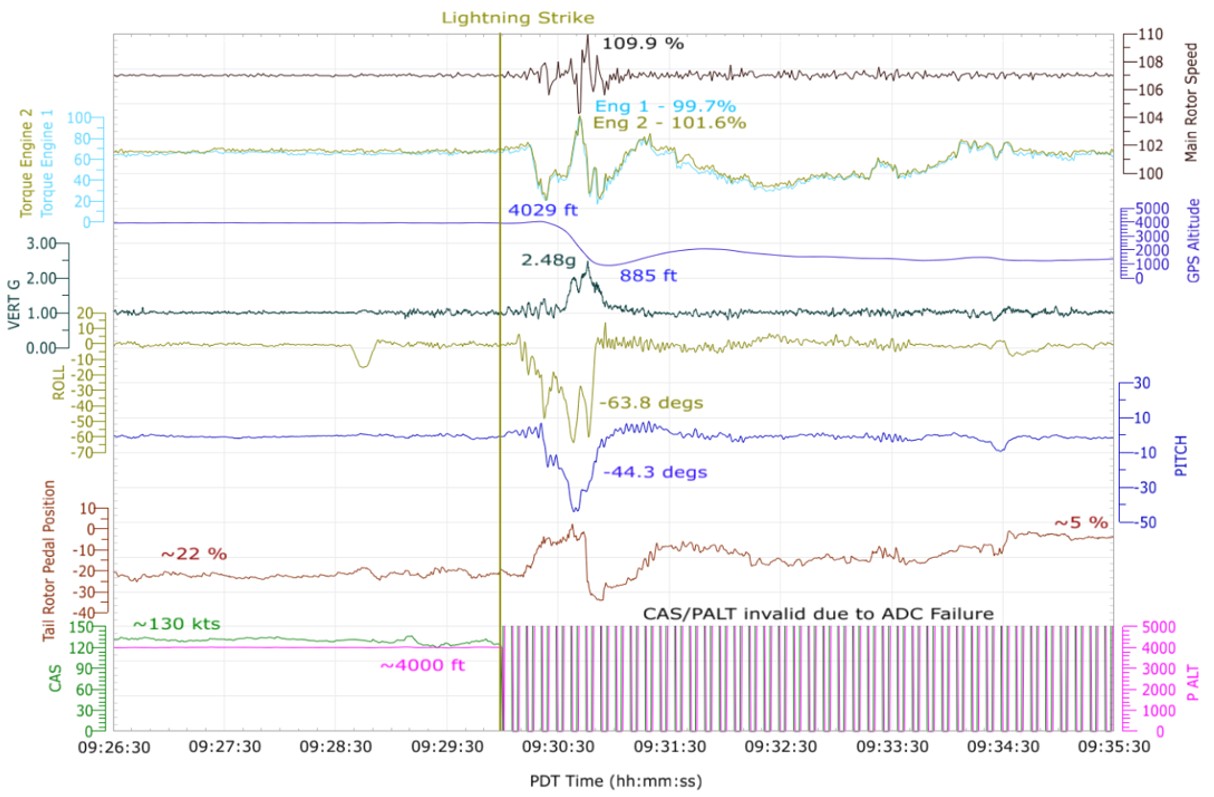
Source: TSB